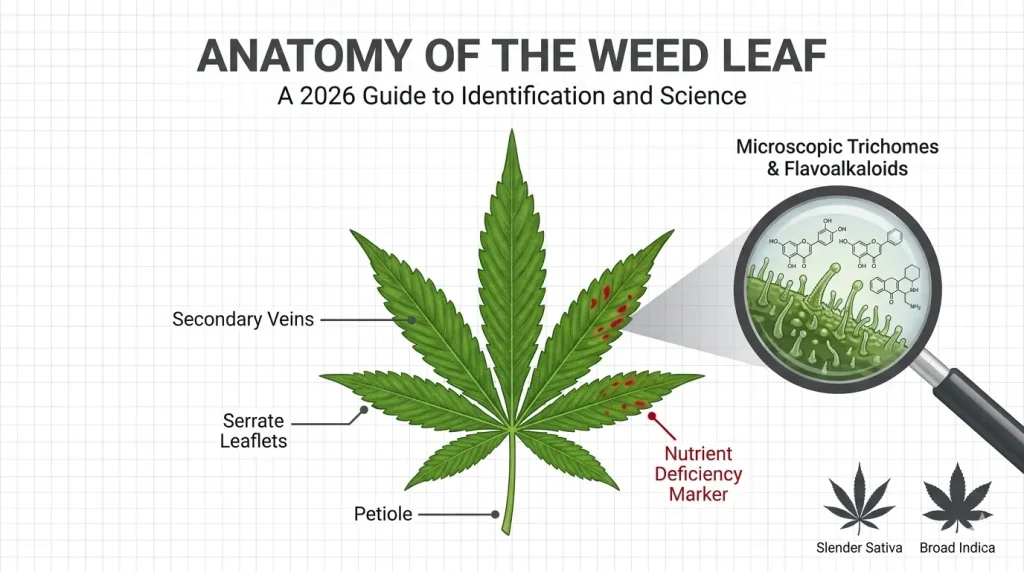
This comprehensive 2026 guide provides an in-depth exploration of the Weed Leaf, the core physical entity of the Cannabis sativa plant. We examine critical anatomical features such as palmately compound structures and serrate leaflets to help you accurately distinguish true specimens from look-alikes like Japanese Maple. This article further reveals the medicinal value of trichomes and the late-2025 discovery of flavoalkaloids, explains how to diagnose plant health through fan leaves (identifying nutrient deficiencies and Leaf Septoria), and traces the symbolic evolution of the Weed Leaf from 20th-century counterculture to its modern status as a legal biomedical heritage. Whether you are a botanical enthusiast or a medical researcher, you will find the most current scientific and cultural insights regarding the cannabis leaf here.
How does Cannabis sativa define its visual identity? Decoding the anatomy of the iconic Weed Leaf
Cannabis sativa defines its iconic visual identity through its unique palmately compound leaf structure, widely recognized as the Weed Leaf. This leaf serves as the plant’s primary photosynthetic engine, capturing solar energy to drive the production of complex chemical compounds. As of 2026, mastering the anatomical morphology of the Weed Leaf is essential for researchers and consumers to distinguish high-quality cultivars from industrial hemp variants.
What are serrate leaflets, and why are they the unique signature of Cannabis sativa?
The unique signature of a healthy Cannabis sativa plant is the presence of serrate leaflets, which are the individual “fingers” of the Weed Leaf featuring distinct, saw-toothed edges pointing toward the tip. These serrations are key diagnostic features, with the depth and frequency of the “teeth” varying based on specific genetic lineages. Beyond identification, these serrated edges facilitate gas exchange and help the plant regulate transpiration across diverse 2026 climates.
Analyzing venation patterns: Why is the scientific structure of the Weed Leaf so important?
The scientific structure of venation patterns in a Weed Leaf is crucial because this network of veins handles the precise transport of water and nutrients throughout the foliage. In an authentic specimen, the secondary veins extend from the midrib and terminate exactly at the tip of each serration. By observing this micro-structure, botanical experts can verify the authenticity of a plant and ensure it is not a deceptive mimic from a different botanical family.
Why are trichomes on the Weed Leaf so important? Exploring the 2026 discovery of rare flavoalkaloids
Trichomes on the Weed Leaf are critically important because these microscopic resin glands serve as the primary chemical factories for synthesizing cannabinoids and the rare flavoalkaloids discovered in late 2025. While fan leaves were historically treated as agricultural waste, research in 2026 has confirmed that these leaves are a vital source of non-psychoactive compounds with significant therapeutic potential.
Mapping trichomes and cannabinoids: How does the chemical factory on the Weed Leaf operate?
The chemical factory on the Weed Leaf operates through glandular trichomes that secrete cannabinoids like THC and CBD, although their concentration in leaves is roughly ten times lower than in matured floral buds. These glands also produce terpenes, which create the “Entourage Effect” that modulates the plant’s overall impact on the human body. In the 2026 market, kief extracted from the Weed Leaf has become a popular sustainable alternative for those seeking moderate potency.
Beyond THC and terpenes: How did scientists unlock the biomedical potential of Weed Leaf phenols?
Scientists unlocked the biomedical potential of the Weed Leaf by identifying flavoalkaloids, a new class of 79 phenolic compounds first reported in cannabis foliage by South African researchers in late 2025. These rare molecules, including cannflavins and specific alkaloids, exhibit potent anti-inflammatory and antioxidant properties not found in high concentrations within the flower. This discovery has officially shifted the 2026 pharmaceutical industry toward “whole-plant” utilization, turning the Weed Leaf into a biomedical goldmine.
How do you identify a true Weed Leaf? Comparing Cannabis sativa with look-alike plants
Identifying a true Weed Leaf requires a precise examination of the Cannabis sativa phyllotaxy (leaf arrangement) and the presence of resinous trichomes. While the seven-pointed Weed Leaf silhouette is famous, species like Japanese Maple share similar shapes, often leading to misidentification. In 2026, mastering these micro-botanical differences is mandatory for anyone involved in the legal cannabis industry or botanical research.
Indica vs. Sativa: How does leaf width reveal the genetic blueprint of the Weed Leaf?
The width of the Weed Leaf directly reveals its genetic blueprint: Indica-dominant varieties typically display broad, dark green leaflets with a compact structure, while Sativa-dominant lineages feature slender, elongated leaflets of a lighter green hue. This disparity reflects the plant’s geographic origins—Indicas evolved in cooler mountainous regions requiring broad leaves to capture sunlight, while Sativas adapted to humid tropical environments where slender leaves allow for better airflow.
Spotting Japanese Maple mimics: How to use anatomical details to verify a real Weed Leaf?
To verify a real Weed Leaf and rule out the Japanese Maple (Acer palmatum), you must check the leaf arrangement on the stem; Maples have “opposite” leaves, whereas Cannabis sativa displays an alternate or decussate arrangement depending on its age. Additionally, maple leaves completely lack the sticky, resinous trichomes that give the Weed Leaf its characteristic pungent aroma and texture.
Why are fan leaves essential indicators of plant health? Diagnosing Leaf Septoria and nutrient deficiency
Fan leaves are essential indicators of plant health because they act as a “communication interface” for Cannabis sativa, showing early visual signs of physiological stress through discoloration or changes in posture. By monitoring these large Weed Leaves, growers can adjust environmental parameters in real-time. In 2026, regenerative farming techniques rely heavily on these visual cues to ensure sustainable and high-yielding harvests.
| Weed Leaf Symptom | Potential Health Issue | 2026 Recommended Action |
|---|---|---|
| Yellowing between veins (Chlorosis) | Magnesium Deficiency | Apply an organic Cal-Mag supplement |
| Circular brown spots spreading | Leaf Septoria (Fungal) | Increase airflow and remove infected foliage |
| Leaf petioles turning purple | Cold stress or genetics | Monitor and raise nighttime temperatures |
| Leaf tips appearing “burnt” | Nutrient Burn (Over-fertilization) | Flush the medium with pH-balanced water |
Reading the “praying” stance: How does photosynthesis signal peak vitality in a Weed Leaf?
The “praying” stance of a Weed Leaf—where leaflets tilt upward at a 45-degree angle toward the light—signals that the plant’s photosynthesis and metabolic rates are at peak efficiency. This posture indicates that the water turgor pressure within the Cannabis sativa plant is optimal. It is a strong visual signal that the plant is thriving and maximizing CO2 intake through the stomata on the leaf’s underside.
Managing discoloration: How to identify nutrient gaps before they impact the harvest?
Identifying nutrient gaps before they impact the final harvest involves observing specific discoloration patterns on the older, lower Weed Leaves. For example, a nitrogen deficiency causes uniform yellowing, while a phosphorus deficiency leads to dark, metallic-looking splotches. Addressing these gaps immediately prevents Cannabis sativa from “cannibalizing” its own tissues, thereby preserving the final yield and cannabinoid quality.
Why do we value the Weed Leaf symbol? Tracking the evolution from counterculture to 2026 heritage
We value the Weed Leaf symbol because it has evolved from a mark of social rebellion into a 2026 global icon for the green economy, wellness, and agricultural heritage. Historically rooted in spiritual practices like the worship of Lord Shiva, the image became a hallmark of 20th-century counterculture. Today, the leaf is increasingly viewed through the lens of biomedical science and sustainable development.
Understanding the 0.3% THC threshold: How does this define the legal line for the Weed Leaf?
The 0.3% Total THC threshold is the absolute international legal standard that separates industrial hemp from marijuana. Following major U.S. federal policy shifts in 2025, this line is strictly enforced through laboratory testing (HPLC) of the Weed Leaf and flowers. Understanding this threshold is vital for farmers to ensure their cannabis crops remain compliant with 2026 agricultural regulations.
Revisiting 420 rituals: How has the global perception of the Weed Leaf changed in 2026?
The global perception of the Weed Leaf in 2026 has transformed “420” culture into a sophisticated commercial and wellness ecosystem that transcends its stoner-rock origins. Current discussions around the Weed Leaf emphasize its role in senior wellness and chronic pain management, reflecting a demographic shift toward older consumers. What was once a “drug culture” symbol is now a recognized emblem of cutting-edge medicine and sustainability.
FAQ
Does a Weed Leaf typically have 5 or 7 leaflets?
Most mature Cannabis sativa plants produce a Weed Leaf with 7 or 9 leaflets, although seedlings or plants under environmental stress may only grow 3 or 5 leaflets.
Is it bad to smoke a Weed Leaf?
Smoking a Weed Leaf (specifically the fan leaf) is generally a poor experience because the chlorophyll content is very high and the THC level is very low, leading to harsh, acrid smoke that can cause throat irritation and headaches.
Can we eat a raw Weed Leaf?
We can eat a raw Weed Leaf, and it is highly nutritious. Raw cannabis leaves contain vitamins, minerals, and the non-psychoactive cannabinoid acid THCA; eating them without heat (decarboxylation) will not produce any “high” effect.
Will a Weed Leaf get you higher?
A Weed Leaf will not get you significantly higher because its THC concentration is much lower than that of the top buds. While the leaf surface does possess some resinous trichomes, they are not present in sufficient quantities to be an efficient method for achieving psychoactive effects.
Does cannabis always have to be burned?
Consuming cannabis does not have to involve burning; in 2026, popular and healthier methods include vaporization, infusing the Weed Leaf into oils for tinctures, and raw juicing to preserve temperature-sensitive medicinal compounds.
Which part of the plant should be smoked?
For significant potency, one should smoke the dried and cured female floral buds (colas). Compared to the Weed Leaf, these buds contain the highest concentration of trichomes and active cannabinoids for medical and recreational use.
References
- Cannabis (drug) (Wikipedia)
- Don’t toss cannabis leaves. Scientists just found rare compounds inside (ScienceDaily)
- This Is What a Healthy Cannabis Plant Is Supposed to Look Like (YouTube – Bud Fellas)