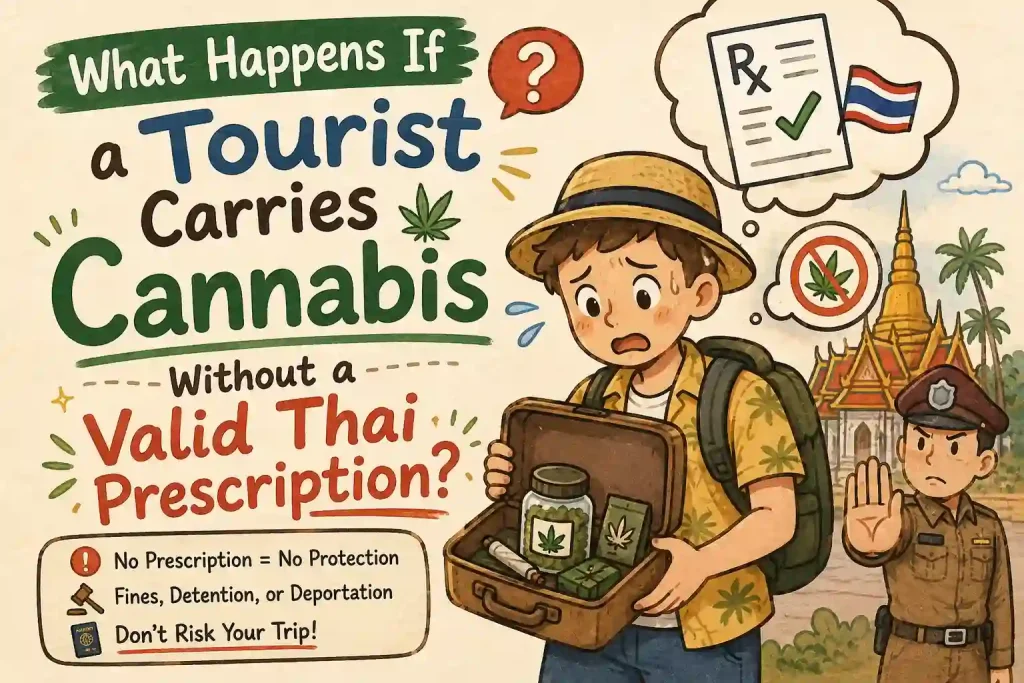
The First Five Minutes: From Backpack to Evidence Bag
Police transform your casual possession into formal evidence within minutes of discovery. cannabis thailand laws explicitly reject foreign documentation, meaning your California medical card or recreational use arguments carry zero legal weight. Officers will classify unauthorized possession as contraband rather than medicine, regardless of your home country’s regulations.
Documentation standards create an immediate trap for unprepared travelers. Thai police require prescriptions issued by licensed Thai physicians that strictly match the 30g monthly limit; without this specific paperwork, possession becomes a violation of the Public Health Act. The authorities show no interest in your “but it is legal back home” defense, treating international cannabis cards with the same validity as gym memberships.
On-the-spot inventory procedures eliminate any opportunity for quick explanations. Officers will weigh and photograph your stash immediately, creating an evidence chain faster than you can unlock your phone. Every gram potentially shifts your classification from “user” to “dealer” territory, with quantities and proximity to sensitive zones like schools or temples determining whether you face administrative fines or criminal charges.
Detention outcomes vary wildly during those initial minutes. Depending on quantity and location, you might trade your beach plans for a station holding cell while authorities determine the severity of your violation. This detention roulette offers no fixed timeline—some tourists resolve matters with fines, while others remain in custody pending criminal charge evaluation.
Counting the Cost: Fines, Courts, and Criminal Records
Penalties range from administrative fines to criminal prosecution depending on quantity and intent. The Public Health Act imposes fines up to 25,000THB and/or imprisonment reaching three months for possession or public odor violations, treating cannabis in public spaces as a biological nuisance rather than a personal health choice.
Administrative violations create permanent digital footprints even without criminal conviction. These records enter Thai criminal databases, creating bureaucratic tattoos that outlast your suntan and complicate future visa applications. What seems like a minor fine becomes a lasting immigration obstacle.
Criminal procedures activate for larger quantities or distribution suspicions, introducing legal uncertainty into your case. Unlike fixed sentencing tables common in Western jurisdictions, Thai courts evaluate case specifics individually, creating outcomes that depend entirely on judicial discretion and factual circumstances. This variability means two tourists with identical quantities might face radically different sentences based on arrest location or officer interpretation.
The distinction between administrative and criminal charges determines your long-term travel freedom. Administrative fines under the Public Health Act typically apply to small-scale possession without prescriptions or public consumption, while criminal charges emerge when authorities suspect distribution intent or discover repeat offenses.
The Exit Strategy: Deportation and Long-Term Bans
Serious violations trigger immigration detention, deportation, and potential blacklisting under Section 12 of the Immigration Act. Criminal charges or significant quantities usually land tourists in the Immigration Bureau’s holding facility—a concrete environment with significantly fewer amenities than your Airbnb—while authorities book your one-way flight home.
Blacklisting mechanics operate automatically for many cannabis convictions. Section 12 provisions can render future Thailand access as likely as a snowstorm in Bangkok, with bans potentially extending years or permanently depending on violation severity. This immigration consequence operates independently of any criminal sentence completion.
Global database synchronization extends Thai penalties far beyond Southeast Asia. Criminal records sync with international law enforcement systems used by the US, UK, Canada, and Australia, meaning your Phuket arrest might surface during job background checks in London or border crossings in Vancouver years later. That joint you carried in Bangkok becomes a permanent component of your international travel profile.
Deportation timing varies by case severity. Minor administrative violations might resolve with fines without immediate removal, but criminal procedures typically accelerate immigration detention and removal proceedings. Think of it as a traffic light that skips straight from yellow to red—once criminal procedures begin, your vacation ends in a holding cell followed by mandatory departure.
FAQ
Can tourists use foreign medical marijuana cards as valid prescriptions in Thailand?
No. Thailand only recognizes prescriptions issued by licensed Thai physicians following the June 2025 regulatory changes. Foreign medical cards possess as much legal weight as gym memberships—police treat unauthorized possession exactly the same as having no documentation at all.
What is the difference between administrative fines and criminal charges for cannabis possession?
Administrative fines under the Public Health Act—reaching up to 25,000THB or three months imprisonment—typically apply to public consumption or small-scale possession without prescriptions. Criminal charges enter with larger quantities, distribution suspicions, or repeat offenses, triggering court proceedings where penalties depend entirely on judicial discretion and case facts rather than fixed sentencing tables.
How does a cannabis violation in Thailand affect travel to other countries?
Thailand shares criminal records with international databases used by the US, UK, Canada, and Australia. A conviction—or even an arrest record—can trigger visa denials, entry refusals, or enhanced screening for years. That cannabis you carried in Bangkok might become the reason you explain your life story to an immigration officer in Toronto a decade later.