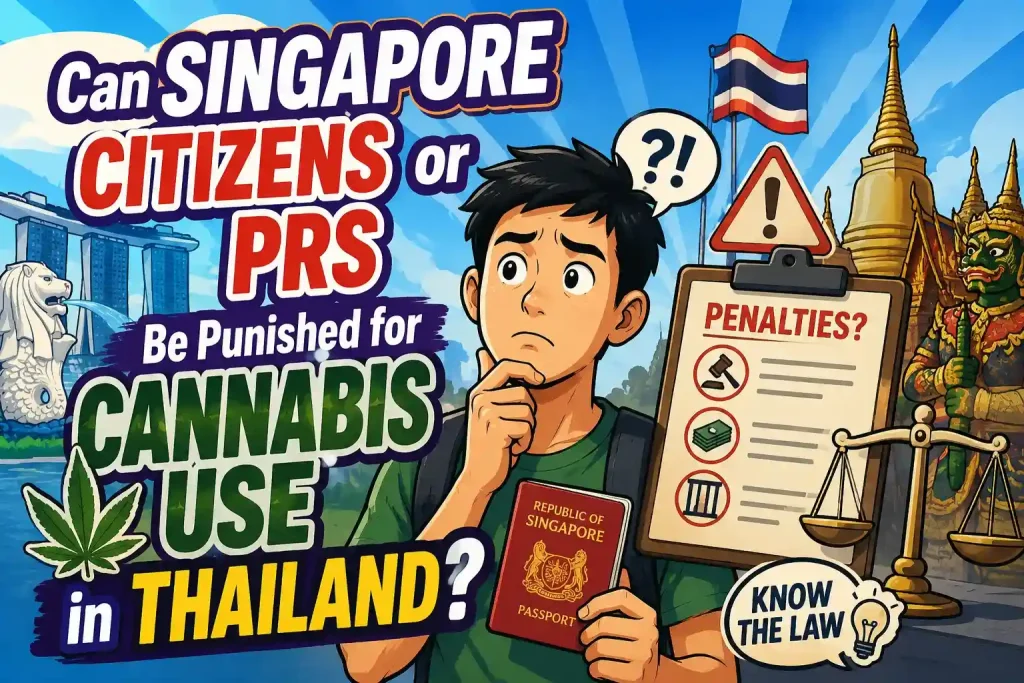
Two Countries, Two Rulebooks: Why Thai Compliance Won’t Shield You
Thai medical cannabis compliance provides absolutely no legal shield when you cross back into Singapore jurisdiction. Singapore courts operate on absolute territorial sovereignty regarding drug enforcement. A Thai medical certificate, dispensary receipt, or doctor’s authorization functions as legally irrelevant paper in Singapore. The Misuse of Drugs Act recognizes no foreign medical cannabis exemptions for citizens and permanent residents. You can possess perfect Thai documentation and still face identical prosecution to someone who smoked illegally on a Bangkok street corner.
Singapore’s legal jurisdiction attaches to your passport like permanent encryption. Section 8A(b) of the Misuse of Drugs Act extends Singapore’s criminal reach beyond physical borders, creating extraterritorial liability specifically for nationals and permanent residents. This legal mechanism functions regardless of which country granted you entry stamps or medical approval. The law treats your biological status—specifically the presence of THC metabolites—as sufficient evidence of commission of an offense, irrespective of geographical origin.
Thai administrative law and Singapore criminal law exist in parallel universes with zero interoperability. You can simultaneously qualify as a model medical patient under Thailand’s Ministry of Public Health regulations and a criminal defendant under Singapore’s Central Narcotics Bureau (CNB) investigation. These dual statuses create no legal paradox because the systems never interact. Compliance with one system automatically exempts you from neither the jurisdiction nor the penalties of the other.
The Citizens and PRs Trap: Why the Law Hits You Harder Than Tourists
Singapore citizens and permanent residents face a unique “consumption crime” under Section 8A(b) that creates liability where tourists walk free. Section 8A(b) of the Misuse of Drugs Act establishes a specific offense for biological possession—detecting THC metabolites in urine—that applies exclusively to citizens and permanent residents. This provision creates liability for consumption itself rather than mere physical possession at the border. Tourists face no equivalent vulnerability; Singapore law cannot prosecute foreign nationals for overseas consumption unless they physically import controlled substances into Singapore territory.
Tourists commit offenses under Singapore law only when caught carrying actual cannabis through customs checkpoints. Citizens and permanent residents, however, commit offenses simply by metabolizing cannabis abroad, because Singapore claims extraterritorial jurisdiction over the bodies of its nationals. Your urine becomes the crime scene; the metabolites function as evidence smuggled internally rather than externally. This distinction transforms a legal Thai dispensary visit into a potential Singaporean felony charge.
Work pass holders and employment permit holders occupy ambiguous legal territory depending on specific visa categories and duration of stay abroad. Citizens and permanent residents enjoy no such ambiguity. Their permanent status creates irrevocable bonds to Singapore’s legal apparatus that persist regardless of passport stamps, duration abroad, or claimed residency elsewhere. The law treats PR status as permanent allegiance, making extraterritorial jurisdiction inescapable.
The Changi Checkpoint Reality: How CNB Turns Holidays into Court Dates
The urine testing protocol at Changi Airport and other immigration checkpoints operates as the primary enforcement mechanism for overseas cannabis consumption, detecting use from weeks prior. THC metabolites remain detectable in urine for days or weeks following consumption, functioning as biological receipts that timestamp your Thai activities. CNB officers conduct targeted testing based on behavioral profiling, travel patterns, and intelligence rather than random selection. A positive result requires no additional evidence of possession or importation; the metabolite presence alone constitutes legal proof of drug consumption under Singapore law.
A positive urine sample triggers immediate criminal charges under the Misuse of Drugs Act, potentially carrying maximum penalties including imprisonment terms, substantial fines determined by court discretion, and mandatory rehabilitation orders. The prosecution requires no physical drug evidence, no witness testimony, and no proof of specific dates or locations of consumption. Your body chemistry becomes the entire case against you.
Beyond immediate judicial penalties, a consumption conviction generates a permanent criminal record that functions as a professional anchor. This record affects banking license applications, professional certifications, and visa applications for third countries including the United States, United Kingdom, Canada, and Australia. The digital permanence of Singaporean criminal records creates lifelong collateral consequences exceeding the initial sentence duration.
FAQ
Can Singapore citizens legally consume cannabis in Thailand if they have a medical prescription?
No. While a Thai medical prescription establishes compliance with Thai law, Singapore’s Misuse of Drugs Act does not recognize overseas medical cannabis use as a legal defense for citizens and permanent residents. You remain fully liable for prosecution upon return to Singapore regardless of medical documentation.
How does CNB actually detect cannabis use that happened in Thailand?
Through urine testing at Changi Airport and other immigration checkpoints. THC metabolites remain detectable in your system for days or weeks after consumption, and under Singapore law, a positive urine sample constitutes legal proof of drug consumption without requiring additional evidence.
What is the difference in legal risk between a Singapore citizen and a tourist who both smoke cannabis in Thailand?
Tourists commit no offense under Singapore law unless caught physically importing drugs into the country. Citizens and permanent residents, however, commit an offense simply by consuming cannabis abroad due to Section 8A(b) of the MDA, which grants Singapore extraterritorial jurisdiction over its nationals and permanent residents.