In cannabis language, a strain is usually a named variety or a commercial label used to distinguish one cannabis product from another. The name may refer to lineage, appearance, aroma, expected characteristics, or a set of user-reported experiences. It is useful shorthand, but it is not a universal scientific, medical, or legal category.
What does ‘strain’ mean in weed?
In everyday use, strain often means a named cannabis line or product identity. “Blue Dream”, “OG Kush” or another familiar name helps people refer to a product without describing every genetic and chemical detail each time. A name can be useful for recognition and conversation, especially when a reader is comparing products from the same producer.
But a name is not the same as a laboratory result. It does not automatically tell you the current THC or CBD level, the terpene profile, the growing conditions, the harvest date, or how the product was stored.
A plain-English definition
Depending on context, strain can describe a cultivated line, a named variety, a hybrid lineage, or a retailer’s menu grouping. Those uses overlap, but they are not interchangeable. A grower may use the word to describe genetics, while a shop may use it as a convenient product label. A review may use it to describe one product experience.
The safest reading is therefore: strain tells you which name or category the writer is using; it does not, by itself, prove what is in the package or how a particular person will respond.
If you need the broader explanation of indica, sativa and hybrid categories, see our guide to the different types of weed in Thailand. This article stays narrower: it explains what the word strain means and where its limits begin.
Strain, cultivar and variety: related terms, not perfect synonyms
The words strain, cultivar and variety are often used as if they mean exactly the same thing. In real cannabis writing, their boundaries are less consistent.
Cultivar and variety
Cultivar is a plant-breeding term for a cultivated variety selected for particular characteristics. Variety can be used more broadly for a plant group with shared traits. A named cannabis line may have a breeding history, but the name on a menu does not prove that the seller is using a genetically stable or consistently documented line.
The word strain is more common in consumer language. It is easy to understand and widely used in menus, reviews and educational pages, but it can compress several different ideas—genetics, appearance, aroma, reported effects and marketing—into one word.
Strain as popular market shorthand
The practical meaning often depends on who is using the label. A breeder may be talking about lineage. A retailer may be organizing a menu. A reviewer may be describing one product experience. None of those uses should automatically be promoted into a formal chemical or clinical classification.
This is also why two articles can use strain differently without necessarily contradicting each other. One may mean a named cultivar; another may mean a recognizable retail product; a third may use it as an umbrella term for a set of related products.
Chemotype and composition
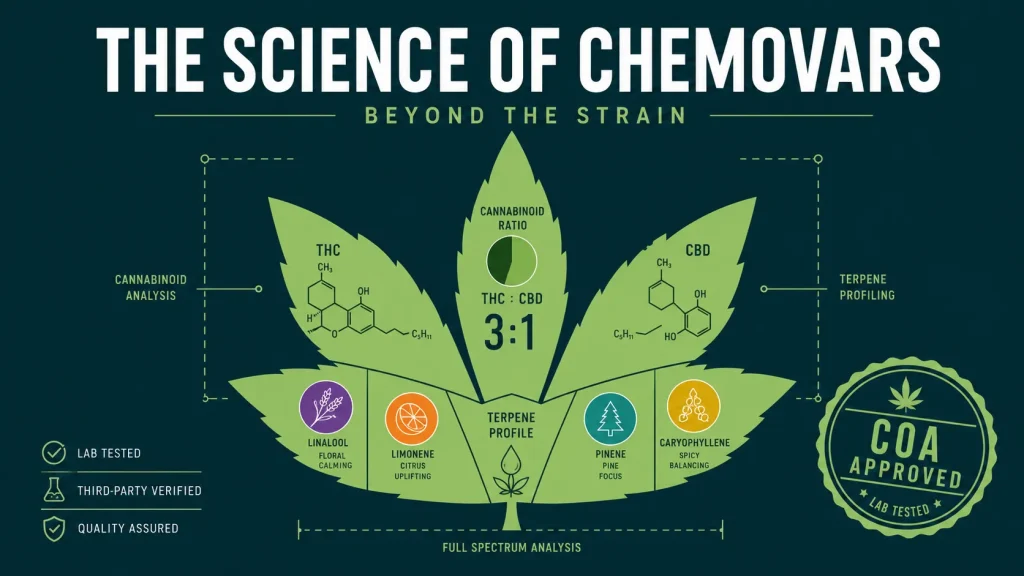
Chemotype is a composition-focused idea. It refers to the chemical profile of a plant or product, including patterns in cannabinoids and terpenes. That language is closer to what a laboratory can measure than a famous name is.
A strain name and a chemotype may be related, but they are not the same thing. The name is a label; the chemotype is a way of describing measurable chemistry. Keeping those concepts separate prevents a marketing name from being mistaken for a test result.
Why a strain name does not guarantee an effect
A familiar name can create an impression of consistency, but cannabis products can change across producers, environments and batches. Leafly’s glossary notes that the same named strain may differ from one grower or batch to another. Research has also found that commercial labels do not consistently align with observed cannabinoid and terpene chemistry.
Producer, genetics and batch matter
The same name can be attached to material with different genetics, cultivation conditions, harvest timing, drying, storage and processing. Even when the name is used honestly, those variables can change aroma, appearance and chemical composition.
This does not make the name useless. It means the name is a starting point for a question, not the final answer. If a product label provides batch-specific information and identifies the producer, it gives the reader more context than a name alone.
Indica, sativa and hybrid are not guarantees
Indica, sativa and hybrid are familiar menu labels, but they should not be treated as guaranteed effect categories. They can help organize a catalogue or communicate broad expectations, yet they do not reliably predict a person’s response or prove a medical outcome.
The child-page purpose here is not to repeat the full category comparison in the pillar article. The key point is narrower: these labels are examples of how the cannabis market uses shorthand. They are not a substitute for product-specific evidence or professional assessment.
What research says about labels
One study of commercial cannabis samples found that commonly used labels did not consistently match the measured chemical diversity of the samples. Another study found substantial terpene variation among plants carrying the same cultivar label. These findings do not mean every label is wrong. They mean the label should be interpreted with the batch, producer and available test information in view.
What to read beyond the strain name
When a product description includes more than a name, the additional information is usually more useful for comparison. It still does not predict an individual outcome with certainty, but it can make the description more concrete.
THC, CBD and ratios
THC and CBD are measurable cannabinoids commonly shown on product documentation. A ratio or percentage describes composition; it does not automatically tell you what amount is appropriate, whether a product is suitable for a condition, or how it will interact with other medicines.
Thailand’s Department of Medical Services guidance discusses medical cannabis products in terms of cannabinoids, ratios, patient assessment and monitoring rather than relying on commercial strain names. That is an important distinction between product data and marketing language.
Terpenes and aroma information
Terpenes are aromatic compounds that contribute to cannabis smell and flavour. A terpene profile can help describe a product’s chemistry and sensory character. It should not be rewritten as a guaranteed mood, sleep, pain or anxiety result.
The research literature shows that terpene profiles can vary and that the same cultivar label may contain different chemical patterns. For a careful reader, terpene information is best treated as descriptive and comparative—not as a treatment plan.
Batch-specific data and traceability
The most useful supporting information is tied to a specific batch and producer. Depending on the product and jurisdiction, that may include cannabinoid values, terpene information, production or harvest details, testing documentation, and storage context.
If a page provides only a famous name and a promise about how you will feel, its evidence is limited. If it provides traceable, batch-specific composition, the reader has something more concrete to discuss with a qualified professional or to compare as product information. Neither type of label should be treated as a legal authorization.
What ‘strain’ does not mean in Thailand’s medical context
In Thailand, a strain name is not a prescription, a diagnosis, an approved indication or proof that a seller is authorised to supply cannabis flower. Current Division of Medical Cannabis guidance describes a regulated medical-service framework in which cannabis flower is supplied through the controlled-herb prescription form PT33, with professional qualifications, records and a maximum 30-day issuance condition.
A strain name is not a prescription
Calling a product “medical”, “indica”, “sativa”, “hybrid” or using a famous strain name does not create a medical indication. It also does not replace a professional assessment or the documentation required by the applicable Thai framework.
This boundary is especially important when a menu uses phrases such as “for pain”, “for sleep” or “for anxiety”. Such wording may be a user report or marketing claim. It should not be treated as clinical evidence or as confirmation that the product is appropriate for a particular person.
The PT33 and professional-assessment boundary
The current Thai framework connects cannabis-flower supply to qualified professionals, patient information, the stated medical basis and record-keeping. A strain name sits outside that chain of evidence. It can identify what a page calls a product, but it cannot prove that the product is prescribed, traceable or suitable for a patient.
For current legal questions, use Thai authority guidance and an authorised professional setting. Do not infer legal permission or medical suitability from a menu label, a social-media post, a review or a familiar name.
FAQ
What does strain mean in weed?
Strain is a common consumer term for a named cannabis variety, cultivated line or commercial product label. It may refer to lineage, aroma, appearance or reported characteristics, but the name alone does not guarantee a specific chemical profile or effect.
Is a strain the same as indica, sativa or hybrid?
No. Indica, sativa and hybrid are broad labels often used to organize cannabis menus. A strain name may sit inside one of those categories, but neither the category nor the name is a reliable guarantee of chemistry, response or medical outcome.
What is the difference between a strain and a cultivar?
Cultivar is a more plant-breeding-oriented term for a cultivated variety. Strain is more common in consumer and retail language. In practice, people sometimes use them interchangeably, so the surrounding evidence—producer, batch and test information—matters.
Why can the same strain name vary by batch?
Genetics, growing conditions, harvest timing, drying, storage, processing and labeling practices can all affect the final product. Research has found variation in cannabinoid and terpene profiles among products carrying similar or identical commercial labels.
Does a strain name prove a medical effect?
No. A strain name is not clinical evidence, a diagnosis, a prescription or a guarantee. In Thailand, medical cannabis questions should be handled through the applicable professional and regulatory framework, with product composition and patient circumstances assessed separately from the name.