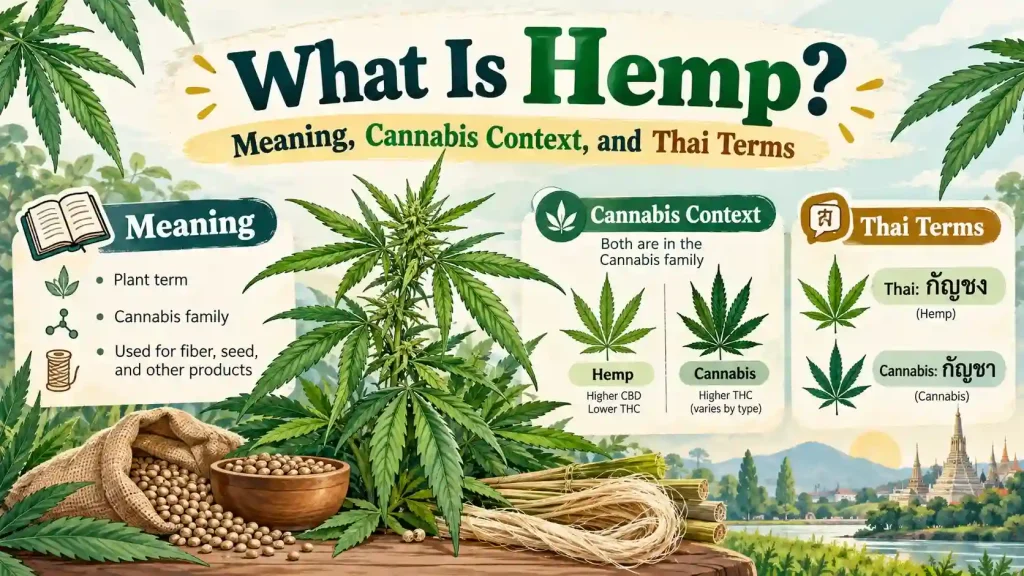
Hemp is a common crop and product label, not a single word that settles botanical identity or legal status everywhere. In cannabis-related contexts, it is often used for Cannabis sativa plants or materials associated with uses such as fiber and seed. The botanical name and a crop label answer different questions, so this guide separates taxonomy from use. Its central table maps hemp across botanical, crop, product, Thai translation, and jurisdiction-specific legal contexts—and shows what the word alone cannot prove. It also explains why Longdo’s several Thai dictionary entries, including one section marked unapproved, should be read as context-dependent translations rather than one guaranteed official equivalent. For Thailand, this explainer does not import a U.S. THC threshold or determine whether a particular product or activity is legal; that requires current official guidance. A short local example lists categories shown on HempThai’s own homepage, such as textiles, construction, food and beverage, and packaging, without presenting one company as a market survey. Readers seeking cannabis strain categories can follow the contextual link to Weedza’s separate types-of-weed guide.
What does hemp mean?
In many crop and product contexts, hemp is a common label for Cannabis sativa grown or processed for uses such as fiber and seed. It describes a use or product context more often than a universally fixed legal category. The University of Wisconsin–Madison’s crop profile, for example, organizes hemp around stalk fiber or hurd, seed, and flower—but that is a U.S. agricultural guide, not a definition for Thailand. University of Wisconsin–Madison Division of Extension.
Hemp is a crop and use label, not a universal legal term
“Industrial hemp” usually points readers toward a crop purpose such as fiber or seed, but the word alone does not tell you which plant part a product contains, its exact chemical profile, or how a particular jurisdiction regulates it. A legal definition belongs to the law that sets it; it is not a botanical fact that automatically travels across borders. So if an English-language page gives a hemp threshold for the United States, do not reuse it as Thailand’s rule.
What the botanical name Cannabis sativa tells you
For the plant taxonomy, Kew’s Plants of the World Online currently accepts Cannabis sativa L. as a species in the genus Cannabis, within the family Cannabaceae. That scientific name is the botanical anchor; “hemp” is a common, crop- or product-oriented word used in particular contexts. The two labels therefore answer different questions: one names a plant in a classification system, while the other often describes how people grow, discuss, or use the plant. Kew’s Plants of the World Online: Cannabis sativa L.
Is hemp different from cannabis or marijuana?
Not necessarily as a different botanical species. “Cannabis” can name the plant genus or be used more broadly in everyday discussion; “hemp” often marks a crop or product use, while “marijuana” is a common term for drug-type cannabis in some sources and places. The wording is not perfectly consistent across dictionaries, industries, or laws.
Hemp and drug-type cannabis describe different use groupings
The University of Wisconsin–Madison Extension describes hemp and drug-type cannabis (commonly called marijuana there) as different types within Cannabis sativa, distinguished in part by their chemical composition. That helps explain why the terms can contrast in agricultural or product discussions without automatically naming different species. It is a U.S. educational framework, however—not a Thai legal test or a universal definition.
Why “cannabis” and “marijuana” need context
Read the surrounding sentence before treating any of these words as a precise classification. A botanical page may use Cannabis as a genus name; a crop page may use “hemp” for fiber- or seed-oriented production; and a consumer or legal page may use “marijuana” under its own local vocabulary. If your actual question is about cannabis or weed strain categories, that is a separate topic from hemp as a crop or material: continue to Weedza’s guide to different types of weed strains in Thailand.
Hemp by context: how to interpret the word in Thailand
The quickest way to avoid confusion is to ask what kind of statement you are reading. The same word may refer to a botanical subject, an agricultural crop, a material or product, a Thai translation, or a category defined by a particular country’s law. Use this table as a reading guide—not as a Thai legal-status checker.
Compare the botanical, crop, product, and translation meanings
| Context | What “hemp” may mean | What the word alone does not establish |
|---|---|---|
| Botanical | In a cannabis context, hemp commonly refers to crop or product groupings associated with Cannabis sativa; Kew accepts C. sativa as a species in the genus Cannabis. | A common label is not a complete botanical identification of a particular plant or product. |
| Crop or use | It may describe production directed toward uses such as stalk fiber or seed. Crop guides can also discuss other plant parts for different production purposes. | It does not tell you which crop purpose, cultivar, or production standard applies unless the source says so. |
| Material or product | “Hemp” may refer to fiber, textiles, seed-related materials, or a product described as hemp-derived. | The word by itself does not identify the exact plant part, ingredients, chemical profile, or manufacturing process. |
| Thai translation | Longdo’s page returns different dictionary entries such as กัญชา, ปอ, and ป่าน; one section marked unapproved gives กัญชง. | A dictionary match is not necessarily the right translation in every sentence, nor an official botanical or legal definition. |
| Legal wording | A law may define a category for its own jurisdiction and purpose. | A foreign THC threshold or an English product label does not, on its own, determine a product’s legal status in Thailand. |
The sources behind these distinctions have different jobs: Kew’s record supports the botanical name; a U.S. university crop guide illustrates crop and product uses; and Longdo shows how dictionary entries can vary. None of those sources, by itself, settles the current legal status of a specific hemp-labeled product in Thailand.
What the word alone cannot establish about Thai law
Before treating “hemp” as a precise answer, check three things:
- Context: Is the source discussing a plant name, a crop purpose, a material, or a legal category?
- Specifics: Does the page identify the plant part or product ingredients, rather than relying on the word “hemp” alone?
- Jurisdiction: Which country issued the definition, and when? A rule quoted for another country is not automatically Thailand’s rule.
This article explains terminology, not current Thai compliance. If a specific product or activity is at issue, verify the applicable Thai requirements through current official sources rather than inferring permission from its label.
One Thailand example: applications listed by HempThai
For a local illustration—not a picture of the whole Thai hemp industry—HempThai’s own homepage lists textiles, construction, food and beverage, and packaging among its hemp-related product areas. The company also describes the plant parts it uses on its farm. These are the business’s published claims, not independently verified market data, proof of certification, or evidence that every category is currently available. HempThai’s homepage.
Treat one company’s product list as an example, not a market survey
A product list can illustrate possible uses, but it cannot show nationwide demand, market scale, licensing status, or whether every item is currently available. That is why this example stays narrow.
FAQ
What does hemp mean?
Hemp is commonly used as a crop or product label for uses such as fiber and seed, but its exact meaning depends on context. It is not, by itself, a universal legal definition.
Is hemp the same plant as cannabis or marijuana?
In many agricultural discussions, hemp and drug-type cannabis are described as different use groupings within Cannabis sativa. “Marijuana” is a common term used for drug-type cannabis in some places. The words are not interchangeable in every botanical, commercial, or legal context.
What is the Thai word for hemp?
There is not one safe translation for every use. Longdo’s dictionary results include กัญชา, ปอ, and ป่าน, while a section marked unapproved lists กัญชง. Read the sentence and the source before choosing a Thai equivalent; the dictionary page is not an official legal definition.
Does a U.S. hemp THC threshold define hemp in Thailand?
No. A threshold in a U.S. source belongs to that source’s jurisdiction; it is not automatically a botanical definition or a Thai legal rule. This article does not determine whether a particular product or activity is legal in Thailand.
What are some hemp applications listed by a Thai business?
HempThai’s homepage lists textiles, construction, food and beverage, and packaging. Those are categories the company itself presents, not a survey of all Thai hemp businesses or proof of current market availability.
References
- Cannabis sativa L. (Royal Botanic Gardens, Kew — Plants of the World Online)
- Hemp (University of Wisconsin–Madison Division of Extension)
- Hemp dictionary results (Longdo Dictionary)
- HempThai (HempThai)