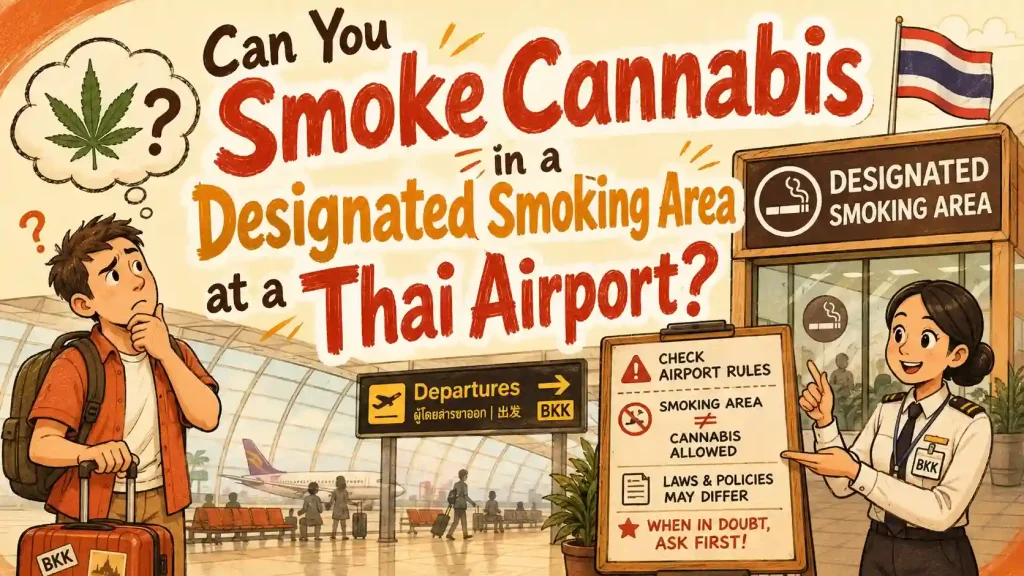
Why Tobacco Permission Doesn’t Equal Cannabis Permission
The legal firewall between tobacco regulations and the Controlled Herb Act makes this distinction absolute and non-negotiable. Thai law treats tobacco as a taxed consumer good governed by excise and aviation safety statutes dating back decades, while cannabis since June 2025 exists strictly as a prescription-only controlled substance monitored by the Ministry of Public Health. These parallel legal tracks never intersect; the permits that allow cigarette sales and designated smoking zones contain explicit statutory exclusions for controlled herbs, creating a regulatory gap that catches many international travelers unaware despite their home country norms.
Airport signage and designated zones speak exclusively “cigarette language” that carries no translation for cannabis. These areas operate under specific excise and aviation regulations that authorize tobacco combustion in controlled environments but remain silent on—or explicitly prohibit—controlled herbs through separate public health mandates. The permissions granted to airport authorities cover nicotine delivery methods only, leaving cannabis combustion and vaporization outside the scope of these accommodations regardless of how the smoking room is labeled, ventilated, or physically separated from main terminals.
The dangerous misconception persists that smoking permissions are location-specific rather than substance-specific, leading to costly legal errors. Travelers often assume that if they can light a Marlboro in a designated zone, they can light anything combustible, but Thai law attaches permissions to the substance classification, not the geographic coordinates. This error ignores that smoking areas represent narrow exceptions to indoor clean-air rules for tobacco exclusively, not blanket licenses for any inhaled substance, and certainly not for materials classified as controlled herbs requiring medical supervision.
The Public Nuisance Bomb (25,000 Baht and Potential Jail)
Thailand’s Public Health Act targets the odor disturbance itself rather than the substance classification, carrying penalties of up to 25,000THB or imprisonment for up to three months for creating a public nuisance, regardless of whether you legally possess the cannabis. Enforcement focuses on the sensory impact on others rather than the chemical composition of your pocket, meaning the smell wafting from your cannabis triggers liability distinct from any charges related to the herb itself. This “nuisance-first” approach allows prosecution even when no other drug laws are technically broken.
Airports function as high-sensitivity enclosed public spaces where smell travels fast through ventilation systems and international scrutiny makes enforcement stricter than on city streets. The enclosed architecture, dense passenger populations, and heightened security presence create an environment where authorities actively monitor for odor violations using both human observation and environmental sensors. Unlike an open street where smoke dissipates naturally, airport smoking rooms concentrate aromas in contained chambers, amplifying the nuisance factor and attracting immediate attention from both public health officers and aviation security personnel.
Stepping just outside the terminal building or into a marked “smoking corner” still constitutes occupying a public place under Thai statutory definitions. These locations trigger the nuisance clause regardless of tobacco permissions, offering no legal shelter for cannabis vapor or smoke. The Public Health Act defines public spaces broadly to include any area accessible to the general population or shared by unspecified groups, meaning that even semi-enclosed patio areas, parking structures, or designated outdoor zones remain fully subject to consumption bans and odor-related penalties.
Medical Prescription? Still a Hard No
A doctor’s prescription purchases the physical product but does not purchase venue rights, creating a rigid legal distinction between authorized possession for medical use and prohibited consumption in public spaces. The Controlled Herb Act authorizes patients to obtain, transport, and store cannabis for therapeutic purposes, yet it deliberately withholds authorization for public inhalation or combustion. This separation means your prescription documentation protects you from possession charges but offers zero defense against public consumption violations, nuisance citations, or airport security interventions.
The monthly 30g limit governs strictly how much cannabis you can obtain from licensed dispensaries, not where you can physically use it. This quantity quota leaves public consumption bans fully intact for medical patients, offering no exemption for airport environments, hotel lobbies, or other public venues. Quantity restrictions and location restrictions operate on independent legal tracks within the statute; possessing 5g legally at home does not translate to smoking 0.5g legally in a public smoking area, regardless of your medical condition or doctor’s authorization.
Airport security and aviation authority rules operate on a separate enforcement track from local public health police, creating overlapping jurisdictions. Even if local officers were not immediately present to detect the odor, aviation security personnel maintain independent authority to detain passengers, initiate narcotics investigations, or impose immediate travel restrictions depending on the circumstances. The airport environment layers multiple regulatory jurisdictions—aviation safety, customs enforcement, immigration control, and public health—creating an enforcement web where medical prescriptions provide no shield against removal from premises, missed flights, or referral to police custody pending investigation.
FAQ
Can I smoke medical cannabis in a Thai airport smoking lounge if I have a prescription?
No. A medical prescription allows you to purchase and possess cannabis, but it does not override the public consumption ban. Designated smoking areas are for tobacco only, and using cannabis there violates both the Controlled Herb Act restrictions and the Public Health Act regarding public nuisance.
What is the penalty for smoking cannabis in a designated airport smoking area?
You may face fines of up to 25,000THB or imprisonment for up to three months under the Public Health Act for creating a public nuisance through odor disturbance, separate from any penalties related to the cannabis itself. Additionally, airport authorities may impose aviation-specific penalties or travel bans depending on the circumstances.
Are Thai airport smoking rooms considered private spaces?
No. Airport smoking rooms and designated outdoor smoking areas remain public spaces under Thai law. Private space exemptions for cannabis use apply only to genuinely private residences or venues where the owner explicitly permits consumption and no public nuisance occurs.