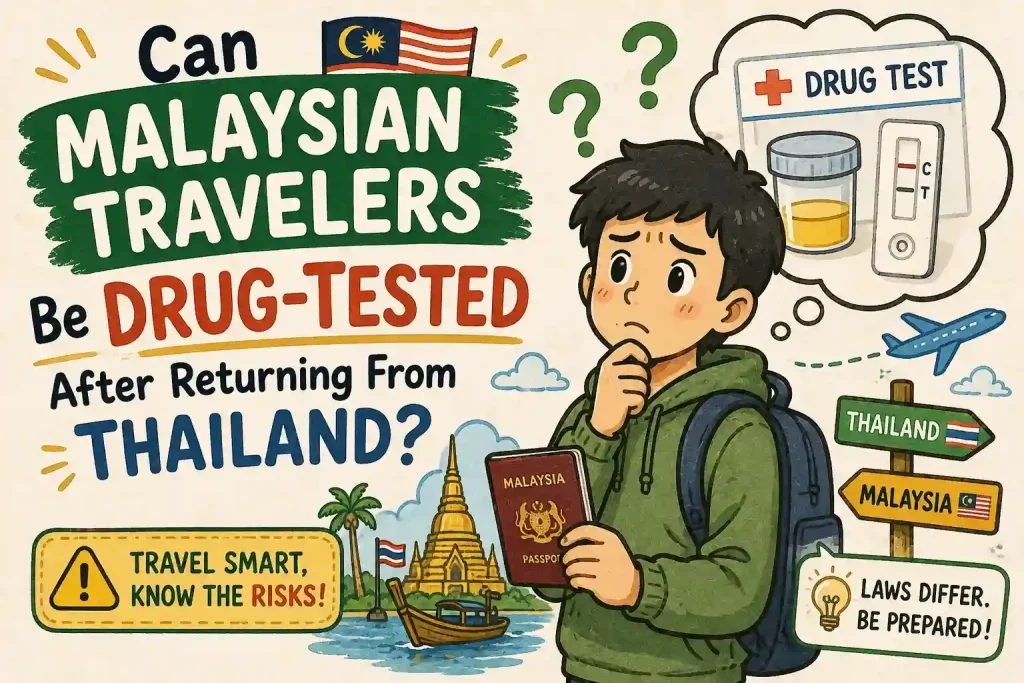
Do Malaysian Authorities Actually Test Travelers Returning From Thailand?
Yes. Malaysian law grants the National Anti-Drugs Agency (AADK) and Royal Malaysia Police absolute authority to conduct random “ujian dadah” (drug testing) without prior suspicion or warrants. The Dangerous Drugs Act 1952 empowers officers to request biological samples from any individual, including citizens returning from Thailand, with refusal potentially constituting a separate offense. This authority extends indefinitely beyond the moment of entry, allowing screening to occur days or weeks after you clear immigration.
Current enforcement priorities specifically target travelers returning from cannabis-legal jurisdictions like Thailand. Border control systems flag incoming passengers for “saringan dadah sempadan” (border drug screening) based on route analysis, travel patterns, and intelligence operations. These initiatives operate continuously at international airports and land crossings, creating elevated scrutiny for anyone arriving from Bangkok or other Thai cities regardless of their stated purpose of visit.
The critical distinction between “they usually don’t” and “they legally cannot” determines your legal exposure. Many travelers interpret the absence of universal testing as legal immunity, a fatal misconception. Malaysian statutes contain no exemption for cannabis consumed abroad; the law criminalizes the presence of metabolites in your system, not the location of consumption. When authorities exercise their screening rights—and they may do so at any time—the lack of routine testing provides zero defense against prosecution.
What Does Initial Screening Actually Look Like?
Border drug screening follows rigid chain-of-custody protocols that transform a routine entry into a formal legal proceeding. Officers selecting travelers for secondary inspection present official documentation requesting urine samples, explaining the statutory basis for the demand and the immediate consequences of non-compliance. This process involves designated collection facilities, sealed containers, and laboratory tracking systems that generate admissible evidence from the first moment of contact.
The mechanics of “ujian air kencing selepas balik dari Thailand” (urine testing after returning from Thailand) proceed rapidly from officer request to sample analysis. Travelers provide specimens under observation, after which officers seal, label, and register each sample with unique identification codes. Preliminary immunoassay testing may occur on-site using portable devices, while confirmatory analysis follows strict protocols at AADK-certified laboratories. Every step creates documentation that forms the foundation of potential legal action.
Preliminary positive results carry immediate legal weight regardless of pending laboratory confirmation. Malaysian enforcement protocols treat initial positive indicators as grounds for detention, passport seizure, and immediate referral to rehabilitation assessment. The interval between preliminary screening and confirmatory results does not function as a legal buffer; authorities may restrict your movement, initiate administrative proceedings, and impose travel bans based solely on early test outcomes. This reality makes the screening moment the beginning of legal jeopardy, not a preliminary inquiry.
Why Assuming “It Won’t Happen to Me” Is a Dangerous Gamble
A “positif THC” result triggers severe legal consequences without exception for foreign legality. Malaysian courts uniformly reject the defense that consumption occurred where cannabis was legal; the Dangerous Drugs Act criminalizes the presence of controlled substances in your system, full stop. This standard applies identically to recreational users and medical patients carrying valid Thai prescriptions—the origin of the substance provides no mitigation against prosecution for metabolite presence.
Unpredictable enforcement patterns make personal risk assessment impossible regardless of your demographics or travel history. Random screening operations deploy without warning across airports, road checkpoints, and urban centers, targeting specific flights, entry periods, or passenger profiles based on intelligence rather than observable behavior. The assumption that professionals, infrequent travelers, or those with clean appearances avoid scrutiny ignores the reality of algorithmic risk assessment and spontaneous checks that disregard individual circumstances.
Testing positive initiates cascading consequences that extend far beyond immediate detention. Mandatory rehabilitation programs under AADK supervision can span months and involve residential treatment, while criminal records affect employment prospects, professional licensing, and civil rights for years. Financial penalties may reach thousands of ringgit depending on the specific charges filed, and travel bans often prevent international movement during investigation periods. These outcomes apply uniformly whether you purchased cannabis at a licensed Bangkok clinic or obtained it through informal channels.
FAQ
Can Malaysian authorities require a drug test weeks after I return from Thailand?
Yes. Malaysian law imposes no statutory time limit preventing AADK or police from requesting urine samples days or weeks after your return. While many travelers associate screening with the moment of entry, authorities retain the right to conduct “ujian dadah” based on subsequent intelligence, random checks, or ongoing investigations regardless of when you crossed the border.
What does “saringan dadah sempadan” involve at Malaysian entry points?
“Saringan dadah sempadan” refers to formal border drug screening operations where travelers provide biological samples, typically urine, for immediate or laboratory analysis. This process involves official chain-of-custody documentation, sealed collection containers, and standardized testing protocols that generate legally admissible evidence. Officers conduct these screenings in designated inspection areas using procedures that carry immediate legal consequences for positive results.
Does having a Thai medical prescription protect me from a “positif THC” charge in Malaysia?
No. Malaysian drug laws do not recognize foreign medical cannabis prescriptions as a legal defense. A “positif THC” result triggers the same enforcement response regardless of whether you purchased cannabis at a Bangkok clinic with proper documentation or obtained it illegally. The presence of metabolites in your system constitutes sufficient grounds for prosecution under current Malaysian statutes, with no exemption for medical use authorized abroad.