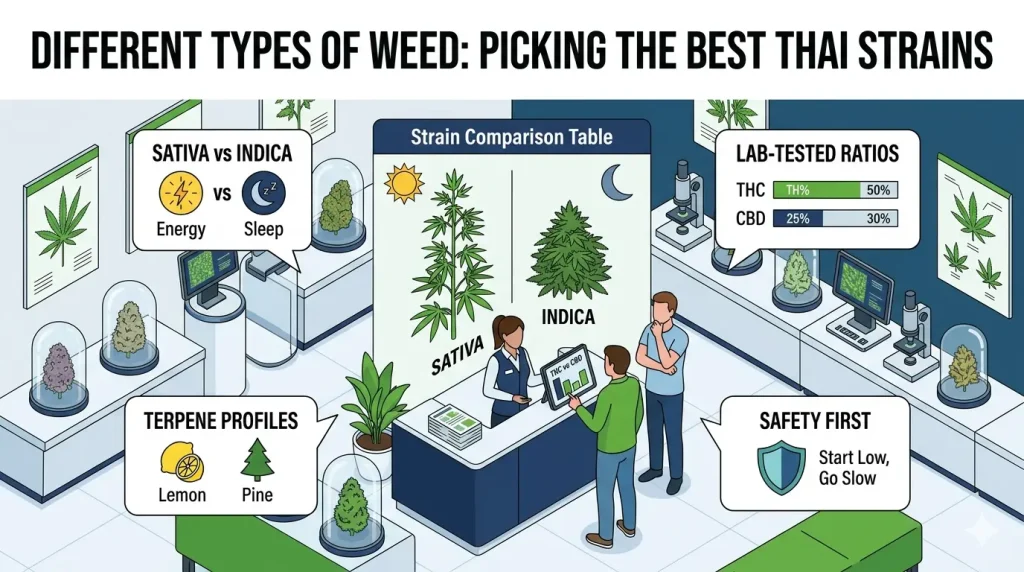
When people ask about the different types of weed, they are usually encountering menu labels—indica, sativa, hybrid, and named strains—rather than strict botanical or medical categories. This guide explains what those labels can and cannot tell you, why strain names do not reliably predict effects, and how measurable information such as THC, CBD, ratios, and terpenes offers a more useful basis for comparison. It also shows how to read strain reviews and “helps with” labels without confusing user-reported effects with clinical evidence.
What “Different Types of Weed” Usually Means in Strain Libraries
When people search for different types of weed, they usually run into the same set of labels: indica, sativa, hybrid, and a long list of named strains. In most strain libraries and dispensary menus, these terms work mainly as organizing categories. They help you browse, filter, and compare products, but they are not strict botanical classifications or reliable medical categories. A strain label can tell you how a seller has grouped a product; it cannot tell you exactly how that product will affect you.
Indica, Sativa, and Hybrid as Menu Categories
In commercial menus, indica, sativa, and hybrid are usually presented as broad effect categories. Indica is often marketed as calming or body-focused, sativa as energizing or cerebral, and hybrid as a middle ground or cross between the two. These descriptions can be useful shorthand when you are scanning a long menu, but they are not standardized clinical terms. Two products labeled “indica” can have very different cannabinoid and terpene profiles, and a hybrid label says little about the actual ratio of its lineage or its batch-specific chemistry.
| Common label | How strain libraries usually use it | What it does not guarantee |
|---|---|---|
| Indica | Often sorted as calming, relaxing, or body-focused | It is not a sedative or a treatment, and it does not reliably predict sleep or pain relief |
| Sativa | Often sorted as energizing, uplifting, or cerebral | It is not a stimulant, and it does not reliably predict focus, anxiety, or energy |
| Hybrid | Used for crosses, mixed lineage, or balanced effects | The term does not tell you the actual ratio, potency, terpenes, or how your body will respond |
Where Strain Names and Aliases Fit In
Strain names and aliases such as “Blue Dream,” “OG Kush,” or local menu nicknames are another layer of labeling. They can be useful for communication if you already know a specific product from a specific producer, but they are not standardized identifiers. The same strain name may refer to different genetics, growing conditions, harvest times, and extraction methods depending on the seller. In practice, a famous name is a marketing and familiarity tool, not a chemical fingerprint.
This matters in Thailand as well. A menu may use imported strain names or local aliases, but the name alone does not confirm the product’s composition, quality, or suitability for a medical question. If you are trying to compare products, the more useful information is usually the batch-specific lab data, the THC and CBD content, the terpene profile, and how the product was produced and stored.
What These Labels Can and Cannot Tell You
Strain categories can help you start a conversation and narrow a menu. They cannot replace measurable product information or professional medical advice. Research on commercial cannabis has found that common strain labels do not consistently predict the actual cannabinoid and terpene composition, which is one reason two products with the same label can feel different.
- What labels can do: organize a menu, provide common language, and give a rough starting point for personal preference.
- What labels cannot do: predict your individual response, confirm medical benefits, replace lab testing, or tell you whether a product is safe with your medicines or health conditions.
- What to look for instead: batch-specific cannabinoid percentages, THC:CBD ratios, terpene information, product form, dose, and advice from a qualified professional when medical use is involved.
In the next sections, I will separate the broad indica–sativa–hybrid framework from the measurable information that actually helps you compare products and ask better medical questions.
Why Indica, Sativa, and Hybrid Labels Are Only a Starting Point
People often ask whether indica or sativa is “better” or which type they should choose. The honest answer is that the indica–sativa–hybrid label is a rough starting point, not a reliable predictor of your experience. In Thailand’s emerging medical cannabis context, this distinction matters even more: a menu label does not determine whether a product is appropriate for a medical condition, and it does not replace a proper clinical assessment.
Individual Response Depends on More Than the Strain Label
Your response to cannabis is shaped by many factors that a strain name cannot capture. These include your medical history, your concurrent medicines, your tolerance, your method of use, the dose, and your own biology. Even two people using the same product from the same batch can report different effects.
This is why I treat strain categories as a conversation starter rather than a prescription. In a clinical setting, a qualified professional would review your condition, your current medications, potential interactions, and your previous experiences before recommending any product. The label on the jar is only one small piece of that picture.
THC, CBD, and the Limits of Predicting Effects
THC and CBD are two of the most discussed cannabinoids, and their concentrations or ratios can be measured and labeled. However, knowing the THC or CBD percentage alone does not fully predict how a product will affect you. Research suggests that individual variation in cannabis response depends in part on THC and CBD, but also on other cannabinoids, terpenes, and personal factors.
For example, a high-THC product may feel very different to a frequent user compared with someone trying cannabis for the first time. A product with a balanced THC:CBD ratio may be better tolerated by some people, but that does not mean it will work for everyone or for every condition. The ratio is useful information, but it is not a guarantee.
When a Category Label Becomes Misleading
Indica and sativa labels become misleading when they are used to make medical claims. You may see a menu say “Indica for pain” or “Sativa for energy,” but those are marketing shortcuts, not clinical evidence. The National Academies’ review of cannabis and cannabinoid research found that evidence for specific medical uses varies widely—some uses have substantial or moderate evidence, while others have limited or insufficient evidence. That evidence is based on cannabinoids like THC and CBD, not on indica or sativa categories.
Another problem is product consistency. Research on commercial cannabis in the United States found that common strain labels do not reliably correspond to the actual chemical composition of the product. So even if a particular indica strain helped you once, a different product with the same label may not have the same composition or effect.
- Do not assume: that indica always means sedating, sativa always means energizing, or hybrid always means balanced for you.
- Do not use: a strain label as a substitute for medical advice, especially if you have a health condition or take other medications.
- Do use: batch-specific lab information, THC and CBD content, terpene profile, and professional guidance to make safer, more informed choices.
In the next section, we will look at what cannabinoid and terpene profiles can actually tell you—and why they are more useful than a famous strain name when you want to compare products.
Cannabinoids, Terpenes, and What a Strain Profile Can Actually Tell You
A strain profile can tell you more than an indica or sativa label, but only if you focus on information that can actually be measured. Cannabinoid profiles, especially THC and CBD, along with terpenes, are the variables that laboratories can test and producers can report. These details help you compare products more objectively and ask better questions, even though they still do not guarantee how you will personally respond.
THC, CBD, and Ratios as Measurable Product Information
THC and CBD are the cannabinoids most often listed on product labels. Their concentrations and ratios can be measured, and they are the basis for how medical cannabis products are standardised in official guidance. Thailand’s Department of Medical Services guidance, for example, describes medical cannabis extracts in terms of THC, CBD, and their ratios rather than by commercial strain names. That is an important distinction: a regulated medical product is described by its composition, while a retail strain name is not a standardised measure of anything.
A ratio such as THC:CBD 1:1 tells you something about the product’s composition, but it does not tell you the dose you should take, whether it is appropriate for your condition, or how it will interact with your other medicines. The same ratio can be formulated into different products with different delivery methods and absorption. So I treat THC and CBD percentages as useful starting data, not as a prescription or a promise of a specific effect.
Terpenes and Aroma Compounds in Commercial Cannabis
Terpenes are aromatic compounds that contribute to the smell and flavour of cannabis. They are also part of the chemical diversity that researchers study when they try to understand why different products may produce different experiences. A 2025 study in Communications Medicine used machine learning on chemical profiles from patients prescribed medical cannabis for chronic pain. The researchers found that including the full chemical composition—including specific terpenoids—improved predictions of pain relief compared with using only demographic and clinical factors. They also noted that THC and CBD alone had limited predictive power.
That study does not mean a particular terpene will treat your pain. It is an observational study, not a randomised controlled trial, and it was not conducted in Thailand. Its value is that it supports a more precise way of thinking: measurable chemistry and individual patient data may matter more than broad strain labels. For a consumer or patient, the practical takeaway is that terpene information can be part of a product profile, but it should not be turned into a medical claim.
Why Batch-Specific Lab Data Beats a Famous Strain Name
A famous strain name is not a reliable substitute for batch-specific lab data. Research on commercial cannabis in the United States found that common strain labels do not consistently correspond to the actual cannabinoid and terpene composition of the product. In other words, the same name can hide very different chemistry. This is why I prioritise information that is tied to a specific batch and a specific producer.
- Batch-specific lab data reports what was actually measured in that product, not what the name suggests.
- THC and CBD values give you a clearer basis for comparing potency and ratio than a strain category.
- Terpene profiles can help you understand aroma and may inform future research, but they are not a treatment plan.
- Product form and production method affect how the product is used, stored, and absorbed.
- Professional assessment remains necessary when you are dealing with a medical condition or other medications.
In practice, a strain profile is most useful when it is specific, recent, and traceable. A label that says “indica” or “sativa” without any lab data is little more than a menu category. A label that includes batch-tested cannabinoids and terpenes gives you something concrete to discuss with a qualified professional.
How to Read Strain Effects, Reviews, and “Helps With” Labels Safely
Strain reviews and menu descriptions often use strong language: “helps with anxiety,” “great for pain,” “perfect for sleep.” These labels can be useful for personal exploration, but they are not clinical evidence. The National Academies’ review of cannabis and cannabinoid research found that evidence for specific medical uses varies widely—some uses have substantial or moderate evidence, while others have limited or insufficient evidence. That evidence is based on cannabinoids like THC and CBD, not on user-reported strain effects. So when you read a review, you need to separate personal experience from medical proof.
User-Reported Effects Versus Clinical Evidence
User-reported effects are what people say they felt after using a product. They can be helpful for understanding common experiences, but they are not controlled, verified, or generalisable. A single review cannot tell you whether a product will help your condition, and it cannot rule out placebo, expectation, or other factors. Clinical evidence, by contrast, comes from studies that follow strict methods and measure outcomes against controls. The National Academies report, for example, found substantial evidence for oral cannabinoids in chemotherapy-induced nausea and vomiting, and for patient-reported multiple sclerosis spasticity symptoms, but only limited evidence for other uses like HIV/AIDS-related appetite loss. That gap between personal reports and clinical evidence is exactly why “helps with” labels should be read with caution.
What “Helps With” Labels Do Not Prove
A “helps with” label does not prove that a product treats a condition. These labels are often based on user surveys, anecdotal reports, or marketing language. Leafly, for instance, states that its “helps with” labels are based on user-reported effects and do not replace professional medical advice. That is an important disclaimer. Research also shows that commercial strain labels do not reliably match actual chemical composition, so even if a particular product helped someone, a different product with the same label may have a different profile. “Helps with” is not the same as “treats,” and it is not a prescription.
- User reports describe individual experiences, not guaranteed outcomes.
- “Helps with” labels often reflect subjective relief, not clinical endpoints.
- Clinical evidence requires controlled studies, not menu descriptions.
- Your medical history and concurrent medicines can change whether any product is safe or appropriate for you.
Questions to Ask Before Trusting a Strain Review
Before you act on a strain review, ask a few practical questions. Who wrote it? Was it based on a single experience or a systematic study? Does it mention the batch, the dose, the method of use, and the duration of effects? Does it account for the reviewer’s tolerance or medical conditions? A good review is transparent about its limits. A review that promises a specific medical outcome without evidence should be treated as marketing, not medicine.
If you are considering cannabis for a medical purpose, the more reliable path is to discuss your condition, history, and medications with a qualified professional who can assess the clinical evidence and your individual risk factors. Strain reviews can help you understand the landscape of products and personal preferences, but they should never replace that professional assessment.
Turning a Medical Question Into an Evidence and Safety Discussion
When someone asks which type of weed is best for a medical condition, the more useful question is: what does the evidence say, and is this product safe for me? Strain categories like indica and sativa are not medical classifications. A proper medical discussion focuses on your condition, your history, your concurrent medicines, the clinical evidence for specific cannabinoids, and the risks of adverse effects and interactions. In Thailand’s regulated medical cannabis system, that discussion should happen with a qualified professional in an approved setting.
Clarifying the Condition, History, and Concurrent Medicines
Before any product is considered, a qualified professional needs to understand your situation in detail. That includes your diagnosis or symptoms, how long you have had them, what standard treatments you have already tried, and whether those treatments were effective or caused intolerable side effects. Thailand’s Department of Medical Services guidance states that medical cannabis products are usually not first-line treatments. They should generally be considered when standard treatments have failed or are not tolerated, and they are often used as an adjunct or combined therapy rather than a replacement for standard care.
You should also be ready to discuss all medications you take, including prescription drugs, over-the-counter medicines, and supplements. Cannabis can interact with other substances, and those interactions can change how your body processes them. Your medical history—such as cardiovascular, psychiatric, or liver conditions—also matters because it can affect whether a cannabis product is appropriate for you. This is not a checklist you can complete by reading a strain name on a menu; it requires a professional assessment.
Reviewing Adverse Effects and Drug Interactions
Every medical product has potential adverse effects, and cannabis is no exception. Commonly discussed effects include drowsiness, dizziness, dry mouth, impaired coordination, and changes in mood or anxiety. Some people may experience more serious effects, especially with high doses or certain product forms. The risk profile depends on the product’s composition, dose, delivery method, and your individual factors.
Drug interactions are another reason to avoid self-prescribing based on strain labels. Cannabis may interact with sedatives, anticoagulants, and other medications, potentially altering their effects or side effects. A qualified professional can review your current medicines, assess potential interactions, and monitor your response. In Thailand, the regulated medical cannabis framework requires professional supervision and, for cannabis flower, a controlled herbal prescription known as PT 33. These requirements exist precisely because safety and traceability matter more than a popular strain name.
Using Clinical Evidence Without Overstating It
Clinical evidence for cannabis and cannabinoids is not uniform across all conditions. The National Academies’ review found substantial evidence for oral cannabinoids in chemotherapy-induced nausea and vomiting, for oral cannabinoids in patient-reported multiple sclerosis spasticity symptoms, and for chronic pain in adults. It found moderate evidence for short-term sleep outcomes in certain conditions, and limited evidence for uses such as HIV/AIDS-related appetite loss and Tourette symptoms. For other uses, such as cancer treatment, glaucoma, and dementia symptoms, the evidence was insufficient or did not support a conclusion.
These conclusions are about cannabinoids like THC and CBD, not about indica, sativa, or hybrid categories. A 2025 observational study on medical cannabis chemical profiles and chronic pain suggested that full chemical composition may improve predictions of pain relief, but it was not a randomised controlled trial and did not test strain labels as medical prescriptions. So when you hear that a particular strain “helps with” a condition, treat that as a starting point for a professional conversation, not as proof that it will work for you. The evidence supports specific cannabinoid formulations for specific conditions under medical supervision—not a general promise tied to a strain name.
What to Confirm About Medical Cannabis in Thailand
In Thailand, medical cannabis is not simply a matter of choosing an indica, sativa, or hybrid product. It sits inside a regulated system that involves approved service settings, professional supervision, product traceability, and prescription requirements. If you are exploring cannabis for a medical purpose, the more important questions are whether the service setting is authorised, who is supervising your care, what product is actually being supplied, and whether that product is appropriate for your condition and medicines. A strain name on a menu does not answer any of those questions.
Qualified Service Settings and Professional Supervision
Under Thailand’s 2026 ministerial regulations, medical cannabis services involving cannabis flower or initial processed products are limited to specific types of authorised settings. According to the Division of Medical Cannabis, Department of Thai Traditional and Alternative Medicine, these include medical facilities or clinics, modern pharmacies, herbal product shops, and the practice premises of certified folk healers. Each type of setting must have appropriate professional oversight—such as a medical, pharmaceutical, Thai traditional medicine, or Chinese medicine professional—and trained staff managing the service during operating hours.
For a patient, this means you should be able to identify who is professionally responsible for the service and how the product is being handled. If a setting cannot clearly explain its authorisation, its supervising professional, or how it stores and traces products, that is a practical warning sign. The same logic applies to online sellers or informal vendors that present cannabis as a general wellness product without any professional assessment. In a regulated medical context, the setting and the supervision are part of the safety framework, not optional extras.
PT 33 and Regulated Herbal Prescriptions
In the Thai framework, cannabis flower is supplied through a controlled herbal prescription known as PT 33 (ภ.ท. 33). This is a regulatory document that links the product to a professional assessment and a traceable supply chain. It is not a marketing label, and it is not the same as a strain name or a menu category. The prescription requirement exists because cannabis flower is not a standardised over-the-counter product; its composition, quality, and suitability need to be assessed in relation to the patient.
If you are considering medical cannabis in Thailand, ask how the product is being prescribed, who is monitoring your response, and what follow-up is available. A legitimate medical service should be able to explain the prescription process, the product’s source, and how your ongoing use will be reviewed. A casual sale that avoids these steps may not provide the safety and accountability that the regulated system is designed to ensure.
Why Strain Names Alone Are Not a Medical Claim
Thai medical guidance describes medical cannabis products in terms of standardised extracts, THC and CBD content, and their ratios—not commercial strain names. That distinction matters because a strain name does not establish an indication, a dose, a safety profile, or a treatment plan. Even research on commercial cannabis has found that common strain labels do not reliably match the actual cannabinoid and terpene composition of the product. So when someone claims that a particular indica, sativa, or hybrid “treats” a condition, that claim should be treated as marketing unless it is supported by clinical evidence and professional assessment.
For readers in Thailand, the practical checklist is therefore: confirm that the service setting is authorised, confirm who is professionally supervising the care, confirm whether a PT 33 prescription is required and how it is issued, and confirm that the product information includes batch-specific composition rather than only a strain name. Then discuss your medical history, concurrent medicines, adverse effects, and interactions with a qualified professional. That is the path that respects both the evidence and the law, and it is the only responsible way to turn a broad question about “different types of weed” into a real medical decision.
FAQ
What are the different types of weed?
In strain libraries and dispensary menus, the most common categories are indica, sativa, and hybrid, along with named strains and aliases. Indica is usually marketed as calming or body-focused, sativa as energizing or cerebral, and hybrid as a cross or middle ground. These labels are useful for browsing, but they are not strict botanical or medical classifications. Research on commercial cannabis has found that strain names do not reliably match the actual cannabinoid and terpene composition, so the same label can hide different chemistry. The more measurable information is usually the cannabinoid profile—especially THC and CBD—along with terpenes and batch-specific lab data. In Thailand’s medical system, products are described in terms of standardised extracts and THC:CBD ratios, not commercial strain names.
What kind of weed is in Thailand?
Thailand has a regulated medical cannabis system rather than an open retail market for medical products. Under the 2026 ministerial regulations described by the Division of Medical Cannabis, Department of Thai Traditional and Alternative Medicine, services involving cannabis flower or initial processed products are limited to authorised settings such as medical facilities or clinics, modern pharmacies, herbal product shops, and the practice premises of certified folk healers. These settings must have appropriate professional supervision and trained staff. Cannabis flower is supplied through a controlled herbal prescription known as PT 33. Menus may use local or imported strain names, but those names do not confirm composition, quality, or medical suitability. What matters is the authorised setting, the supervising professional, the prescription process, and batch-specific product information.
Which type of weed is best?
There is no single best type for everyone. The “best” choice depends on your condition, medical history, concurrent medicines, tolerance, method of use, and dose. Indica, sativa, and hybrid labels are not reliable predictors of individual response, and they are not medical classifications. Clinical evidence for cannabis and cannabinoids is based on specific cannabinoids like THC and CBD for specific conditions under medical supervision—not on strain categories. For example, the National Academies’ review found substantial evidence for oral cannabinoids in chemotherapy-induced nausea and vomiting and for patient-reported multiple sclerosis spasticity symptoms, but limited or insufficient evidence for other uses. If you are considering cannabis for a medical purpose, the safest approach is to discuss your situation with a qualified professional in an authorised setting.
Which is better, indica or sativa?
Neither indica nor sativa is inherently better. The distinction is mainly a menu and marketing convention. Your response depends on many factors, including your biology, tolerance, dose, method of use, and other medicines. Research shows that common strain labels do not consistently correspond to the actual chemical composition of commercial cannabis, so two products with the same label can affect you differently. THC and CBD content, ratios, and terpene profiles may be more informative, but they still do not guarantee a specific effect. For medical use, the evidence is about cannabinoids and standardised products, not about indica versus sativa. A qualified professional can help you interpret product information in the context of your health.
Should a beginner smoke indica or sativa?
For a beginner, the more important question is not indica versus sativa but whether cannabis is appropriate at all, and if so, in what form, dose, and setting. Smoking carries respiratory risks and is not a recommended medical route. THC can cause adverse effects such as anxiety, drowsiness, dizziness, and impaired coordination, especially for people with little tolerance. Strain labels do not reliably predict whether a product will feel manageable or overwhelming. If you are in Thailand and considering cannabis for a medical purpose, you should go through an authorised service setting, speak with a qualified professional, and follow the prescription process, including PT 33 where cannabis flower is involved. Do not self-medicate based on a menu label. If you are asking about recreational use, check the current legal rules and be aware of the health and safety risks.
References
- คำแนะนำการใช้สารสกัดจากกัญชาในทางการแพทย์ (Department of Medical Services, Ministry of Public Health, Thailand)
- คู่มือการจัดตั้งสถานประกอบการให้บริการกัญชาทางการแพทย์ ภายใต้กฎกระทรวงใหม่ พ.ศ. 2569 (Division of Medical Cannabis, Department of Thai Traditional and Alternative Medicine)
- The Health Effects of Cannabis and Cannabinoids: The Current State of Evidence and Recommendations for Research (National Academies of Sciences, Engineering, and Medicine)
- The phytochemical diversity of commercial Cannabis in the United States (PLOS ONE / PubMed)
- Machine-learning of medical cannabis chemical profiles reveals analgesia beyond placebo expectations (Nature Portfolio / Communications Medicine)