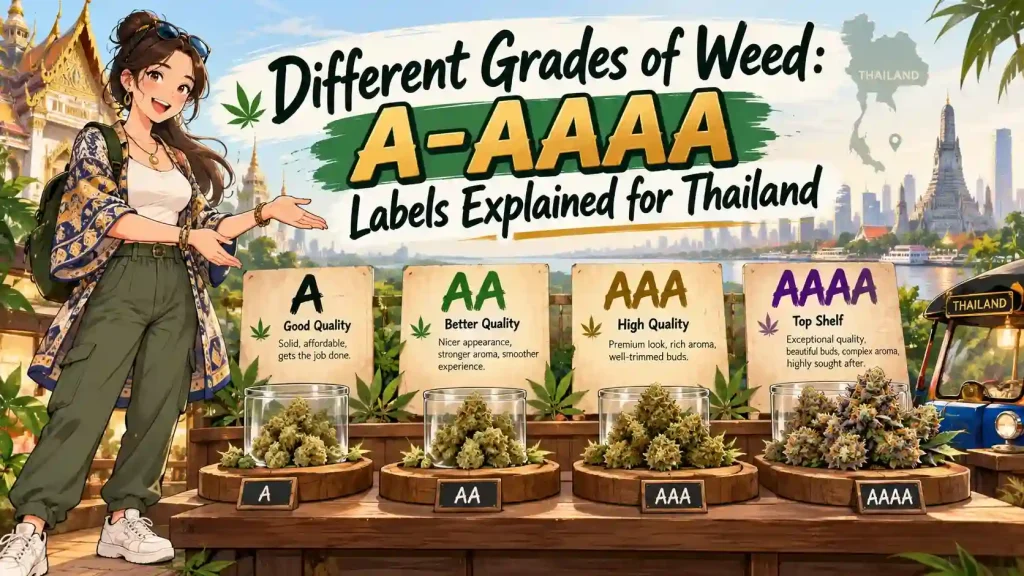
Different grades of weed usually means A, AA, AAA or AAAA labels, shelf terms or slang used to rank flower by a seller’s or market’s idea of quality. The labels are not a single scale with criteria that transfer reliably between sellers. This guide compares those terms with Thailand Cannabis GACP, a Certificate of Analysis (COA), and strain categories such as sativa, indica and hybrid so readers can tell what each describes.
It also weighs conflicting claims about whether A–AAAA is standardized: an industry article calls the system legally recognized, while a retailer guide calls grades seller-defined; the official Thai sources reviewed describe cultivation/harvest practices and specified GACP or COA documentation, not a consumer A–AAAA chart. That is the bounded conclusion supported by the sources—not a claim that every possible grading scheme has been ruled out. GACP is not a residue-free guarantee, and a COA reports only its sample and test scope. A grade, THC number, appearance or ash-colour claim does not by itself verify a batch, establish safety or confer Thai regulatory status. If you meant strain types rather than quality grades, the separate Weedza guide covers that topic.
What “Different Grades of Weed” Usually Mean?
“Different grades of weed” usually refers to labels that rank cannabis flower by perceived or seller-assigned quality—not to one universal scale. A, AA, AAA and AAAA often imply ascending tiers, while “top shelf,” “mid shelf,” “bottom shelf” and slang such as “mids” or “loud” use different kinds of shorthand. The criteria can change between sellers and markets; one retailer guide, for example, describes letter grades as informal and retailer-defined (Green Society’s guide to flower grading).
For Thailand, the official material reviewed here describes cultivation and harvest standards and specified laboratory documentation, but it does not publish a consumer-facing A–AAAA chart. The practical distinction is simple: a grade is a label about relative quality; a certificate or lab report is a document with a defined scope. The sections below compare what each can—and cannot—tell you.
Weed Grade vs Proof: What the Labels and Documents Actually Tell You
The fastest way to avoid mixing up unlike things is to ask what each label or document is describing. This comparison is the article’s main guide: it separates a seller’s quality shorthand from cultivation standards, laboratory analysis and strain categories.
| Term or document | What it describes | What the sources reviewed establish | What it does not prove by itself |
|---|---|---|---|
| A, AA, AAA, AAAA | A relative flower-quality ranking used by some sellers or market guides. | Definitions vary: one retailer guide calls the letters retailer-defined; an industry article calls an A–AAAA+ system legally recognized. The official Thai material reviewed does not set out a consumer A–AAAA chart. | A fixed meaning across sellers, measured THC, a clean lab result, or Thai regulatory approval. |
| Top, mid or bottom shelf | A seller’s relative tier or shelf-position shorthand. | Retail guides use these terms as quality tiers, but the label’s criteria depend on the source. | A government-defined grade or a specific test result. |
| Slang such as “mids” or “loud” | Informal market or cultural vocabulary. | Terms can signal a speaker’s idea of lower, middle or stronger/aromatic flower, but they are not a technical lab scale. | A standardized Thai category, precise potency or contamination result. |
| Thailand Cannabis GACP | Good agricultural and collection practices for cultivation and harvest at the growing site. | DTAM’s GACP conditions describe site/process assessment and state that certification is not testing or certifying a product as free of all chemical residues. | A consumer A–AAAA grade or a laboratory result for every chemical in a particular batch. |
| Certificate of Analysis (COA) | Laboratory results for the sample and analytes covered by that report. | The Thai agency’s 2026 licensing explainer lists a private-lab COA as one documentation route for a specified flower-sales permit application. Health Canada’s separate Canadian guidance explains lot/batch testing for specified cannabinoids. | A seller’s grade, untested substances, or an overall guarantee of quality, safety or legal status. |
| Sativa, indica or hybrid | Strain or type categories, not a flower-quality grade. | These labels answer a different classification question from A–AAAA or shelf terms. | Whether a flower is “premium,” tested or higher quality. |
Use the label for the question it can answer. A grade may tell you how a particular seller ranks flower; a GACP document concerns cultivation and harvest practices; a COA records the tests within its scope. None of those should be treated as interchangeable.
Why Sources Disagree About A–AAAA Standardization
The disagreement comes from sources using different meanings of “standard.” Some describe how sellers rank flower; others make a legal claim about a particular jurisdiction. Those are not interchangeable claims, and the source’s authority has to match the question.
What the industry article and retailer guide each claim
A CannabisTech article published in 2022 says the A–AAAA+ system was established in Canada and is legally recognized. But the page reviewed does not cite a Canadian statute or regulator for that legal status. A Green Society retailer guide takes the opposite position, describing letter grades as informal and retailer-defined. That is useful evidence of how a retailer frames the market, but a retailer is not a government authority on the law either.
What the official sources reviewed establish for Thailand
Health Canada’s official guidance addresses testing and labeling THC, THCA, CBD and CBDA by lot or batch; it does not discuss an A–AAAA grade. That makes it useful for understanding batch-specific analysis in Canada, but it neither proves nor disproves a letter-grade law.
For Thailand, the DTAM GACP document and the Division of Medical Cannabis’s 2026 regulation explainer describe cultivation/harvest assessment and specified GACP or COA documents. They do not define a consumer A–AAAA scale. So the supported Thailand conclusion is bounded but clear: the official material reviewed does not establish A–AAAA as a Thai government grade. Treat the letters as market vocabulary unless someone can point to the specific applicable standard. This conclusion states what the evidence supports; it does not pretend the sources answer questions they never address.
Thai GACP and a COA Answer Different Questions
GACP is about how cannabis is cultivated and harvested; a COA is a laboratory report about the analyses it contains. Neither is another name for “AAAA,” and neither should be read as a complete verdict on every aspect of a flower.
GACP assesses cultivation and harvest practices
Thailand’s DTAM describes its cannabis GACP certification as a growing-site standard for good cultivation and harvest practices. The same document is explicit that certification is not a test or certification that the produce or product is free from all chemical residues; the department may conduct residue analysis in special cases where contamination or risk is suspected. GACP therefore provides process evidence, not a lab result for every batch.
The Division of Medical Cannabis’s explanation of the 2026 ministerial regulation says a grower applying for a specified permit to sell cannabis flower must have the described standard documentation: a GACP assessment by the relevant authority or a private-laboratory COA. That is a licensing-document explanation—not a retail A–AAAA scale and not a statement that every consumer-facing label proves the same thing.
A COA reports the scope of a laboratory analysis
A COA should be read as a report with a defined sample, test method and analytes, not as a universal “quality grade.” For an example of how a regulator ties cannabinoid values to a particular batch, Health Canada says THC, THCA, CBD and CBDA testing applies to each lot or batch in its jurisdiction, and that a COA using a validated method on a representative sample is the most accurate estimate of that lot’s cannabinoid content. That is Canadian guidance, not Thai law; it illustrates why batch identity and report scope matter.
In short, a grade expresses a ranking claim; GACP records cultivation/harvest practice; and a COA reports the specific lab analysis stated in the document. Keep those evidence types separate.
A Grade Is Not a Strain Type
“AAAA” and “sativa” answer different questions. A grade is a seller’s or market’s shorthand for perceived flower quality; sativa, indica and hybrid are type or strain-category labels. A flower’s category does not automatically make it higher- or lower-grade, and a grade does not tell you which category it belongs to.
If you meant the plant-category question rather than quality labels, continue to Weedza’s guide to different types of weed strains in Thailand. That page covers the categories in detail; this article keeps the distinction brief so the two topics stay separate.
What a Grade Cannot Prove
A higher letter can describe a seller’s ranking, but the letter alone does not verify what is in a specific flower batch. It also does not convert a marketing label into official status. Keep these limits in view:
- THC is not a universal grade scale. Some sellers may include potency among their criteria, but the sources reviewed do not establish one A–AAAA-to-THC conversion that applies across sellers or in Thailand. A stated percentage is meaningful as a measured result only when its test and sample scope are clear.
- Appearance and aroma are not chemical tests. Guides may discuss bud structure, trichome coverage, scent or curing when describing perceived quality. Those observations do not establish a specific batch’s cannabinoid content or residue status.
- Ash colour is not a residue report. One industry article presents white ash as a quality cue, but ash colour cannot identify or measure pesticide residues. For residues or cannabinoids, look to an appropriately scoped laboratory analysis—not a visual proxy.
- GACP and COA are not interchangeable guarantees. DTAM says GACP is not certification that a product is free of all chemical residues; a COA, in turn, says only what its sample and listed tests say.
This is why the grade-vs-proof distinction matters: a ranking can be useful shorthand within a seller’s own system, while the evidence needed to establish a measured characteristic is different.
FAQ
Is AAAA always better than AAA weed?
No universal rule makes one seller’s AAAA directly comparable with another seller’s AAA. The letters express the criteria used by that source, so a higher label alone does not establish measured potency, lab-tested cleanliness or an official status.
Is there an official A–AAAA weed grading system in Thailand?
The Thai official sources reviewed for this guide describe GACP and, for a specified flower-sales permit application, GACP or private-lab COA documentation; they do not set out a consumer A–AAAA chart. So the evidence reviewed does not establish the letters as a Thai government grade. A claim that they are legally recognized should identify the applicable primary standard or law.
Does higher THC mean a higher grade?
Not by itself. Some sellers may consider THC alongside other traits, but there is no shared A–AAAA conversion in the sources reviewed. A lab report can give a cannabinoid result for its sample and test scope; that number is not a complete flower-quality grade.
Does Thai GACP certification mean cannabis is free of chemical residues?
No. DTAM’s GACP conditions state that certification is not a test or certification that produce or products are free from all chemical residues. GACP is evidence about cultivation and harvest practices, not a residue result for every product or batch.
Is sativa a grade of weed?
No. Sativa, indica and hybrid are type or strain-category labels; A–AAAA and shelf terms are quality-ranking shorthand.
References
- Thailand Cannabis GACP: Requirements and Conditions for Certification of Good Cultivation and Harvest (Department of Thai Traditional and Alternative Medicine).
- แนวทางการเพาะปลูกกัญชามาตรฐานทางการแพทย์ ภายใต้กฎกระทรวงใหม่ พ.ศ. 2569 (Division of Medical Cannabis, Department of Thai Traditional and Alternative Medicine).
- Displaying THC and CBD content on dried cannabis product labels and kief (Health Canada).
- Understanding the 4-Tier Cannabis Grading System for Quality (CannabisTech).
- Understand cannabis flower grading for smarter purchases (Green Society).