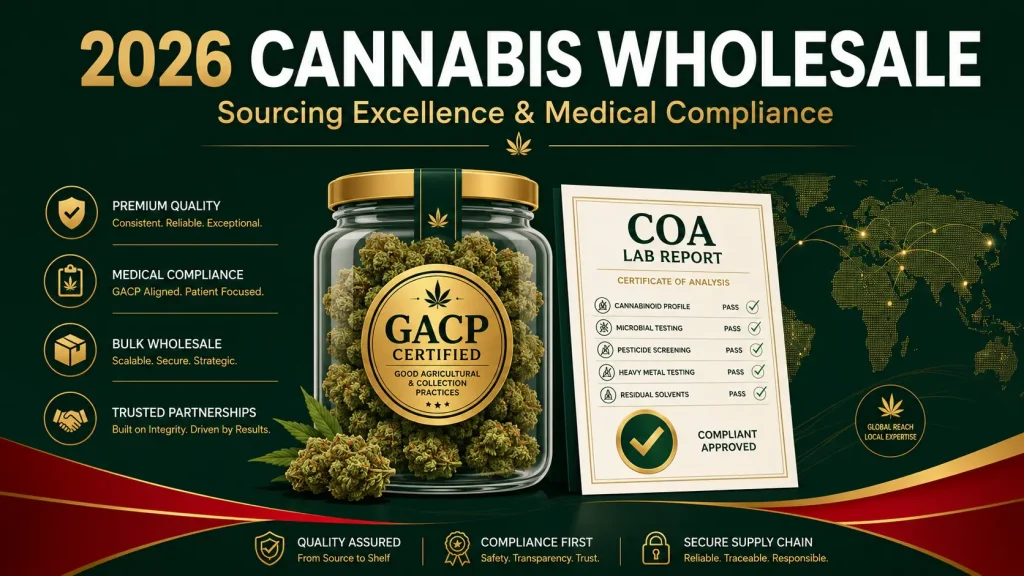
Cannabis wholesale in Thailand should be treated as a regulated B2B inquiry, not a simple bulk-shopping request. A supplier’s farm, catalogue, licence statement, GACP reference or COA may answer one part of the picture, but none of those items alone proves that a proposed seller, buyer, product and transaction are currently eligible. This guide explains the checks to make before contacting a supplier. For the wider visitor rules, see our Thailand cannabis rules guide.
What cannabis wholesale means under Thailand’s current controlled-herb framework
“Cannabis wholesale Thailand” describes a business-to-business supply question involving controlled cannabis flower or related products. It does not create a separate legal category that overrides Thailand’s current controlled-herb rules.
The Department of Thai Traditional and Alternative Medicine (DTAM) states that cannabis flower is a controlled herb and that commercial activities such as sale or processing require the relevant permission. Its 2026 materials also describe a medical purpose and regulated service setting. The exact permission, seller, buyer and product conditions depend on the activity and the parties involved, so a search result or supplier homepage cannot settle those questions by itself.
This is why the first question for a B2B reader is not “What is the cheapest kilogram?” It is “Which legal and documentary checks apply to this proposed relationship, and who must confirm them?”
Why farm ownership and flower-sale authorization are separate checks
A farm statement can describe where a supplier cultivates or sources cannabis. It does not automatically prove that the operator may sell controlled flower for trade, that the intended buyer is eligible, or that a particular batch is available for the proposed use.
DTAM’s 2026 cultivation guidance separates cultivation from commercial flower sales. It explains that a grower seeking to sell flower must apply for the relevant sales permission and identifies categories of licensed counterparties that may receive the product. The same guidance describes GACP assessment or a laboratory COA as evidence routes connected with a flower-sale application. These are separate questions:
- Who owns or operates the cultivation site?
- Does the seller have the current permission required for the proposed flower sale?
- Does the intended buyer belong to a permitted counterparty category?
- Can the specific batch and source records be matched to the proposed transaction?
Who may be an eligible wholesale buyer under current guidance
DTAM’s cultivation guidance names regulated counterparties such as pharmaceutical or herbal-product manufacturers, qualifying importers, medical facilities, pharmacies and herbal-product shops, subject to the applicable permission and conditions. This list is a compliance framework, not a conclusion that every business using one of these labels is automatically eligible.
A buyer should therefore be ready to identify its legal entity, operating activity, premises and relevant permit category. A company registration, a retail website, a dispensary sign or a request for a quote does not by itself establish the right to receive controlled flower.
DTAM’s medical-service guidance also lists permitted service-establishment types and describes the PT33 controlled-herb prescription process for patient dispensing. PT33 belongs to the medical dispensing pathway. It is not a universal wholesale authorization, a digital batch-tracking system or a substitute for the permits that apply to a business transaction.
What GACP and a COA can show—and what they cannot establish alone
GACP and a Certificate of Analysis can be useful evidence, but their meaning depends on the document, issuing body, date, product, batch and regulatory purpose.
- GACP evidence may relate to cultivation and harvesting standards. It does not by itself prove that the operator has the current permission to sell a particular flower batch or that the buyer may receive it.
- A COA may report laboratory findings for a named sample or batch. It does not by itself prove the supplier’s licence, the document’s authenticity, the current stock position, the legal destination or the buyer’s eligibility.
- Batch and source records can help connect a product to its origin and documentation. They still need to be current, internally consistent and relevant to the proposed transaction.
Ask for the document identity, issuing body, date, batch reference and scope. Avoid treating a logo, a screenshot or an unlinked PDF as a complete compliance decision.
A claim-versus-evidence matrix for a Thailand wholesale inquiry
Use this table to structure a conversation with a potential supplier. It is a screening framework, not a legal determination.
| Claim or document | What it may support | What it does not prove | What needs current verification |
|---|---|---|---|
| “We own a legal farm” | A claimed cultivation source or business relationship | Permission to sell controlled flower for this transaction or the buyer’s eligibility | Current cultivation and sale permissions, named seller, proposed buyer and product scope |
| Commercial flower-sale permission | That a responsible authority has granted a permission for a defined activity | That every product, batch, buyer, location or channel is covered | Permit holder, validity, scope, premises, product and permitted counterparties |
| GACP certificate or assessment | Cultivation and harvesting controls within the document’s scope | Wholesale authorization, buyer approval, current stock or legal destination | Issuing body, date, site, crop/batch relationship and current regulatory relevance |
| Certificate of Analysis (COA) | Reported laboratory results for the identified sample or batch | Supplier licence, authenticity, current inventory, transaction legality or medical suitability | Laboratory, report number, sample/batch, date, analytes and chain of custody |
| “Wholesale available nationwide” | A commercial service claim | Lawful fulfilment in every province, current stock, permitted channel or delivery time | Current service scope, legal channel, seller/buyer permissions and direct confirmation |
| Displayed price, minimum order or product menu | A time-stamped commercial indication | Current price, stock, taxes, fees, product continuity or eligibility to buy | Current quotation, terms, batch, quantity, buyer status and responsible contact |
The matrix keeps a useful distinction in view: evidence can support a specific proposition without proving the entire transaction. That distinction is especially important when supplier pages combine farm stories, product claims, medical language and ordering prompts.
How to prepare a qualified inquiry to Weedza
Use the inquiry to clarify whether a current B2B discussion is appropriate. Include enough business context for the support team to identify the relevant questions:
- Your business type and operating location in Thailand.
- The service or product category you are asking about.
- The permit or professional status that applies to your business, if any.
- The documents you need to review, such as current seller permissions, GACP evidence, COA information or batch records.
- The questions that remain unresolved, rather than assuming that a farm claim or menu confirms eligibility.
Ask Weedza support about a wholesale inquiry. This link is an inquiry handoff supplied for this article. It does not confirm a licence, buyer approval, current inventory, price, minimum order, delivery time or completed transaction.
For national visitor context, continue to the Thailand cannabis rules guide. For a high-stakes legal or medical question, confirm the current position with the responsible Thai authority or a qualified professional.
FAQ
What does cannabis wholesale mean in Thailand now?
It refers to a business-to-business supply question involving controlled cannabis flower or related products. The proposed seller, buyer, product and transaction channel must still be checked against current Thai permissions and conditions.
Can a farm sell cannabis flower wholesale to anyone?
No general conclusion follows from farm ownership. DTAM guidance separates cultivation from flower-sale permission and identifies regulated counterparties. The seller’s current authorization and the buyer’s eligibility must be reviewed for the proposed transaction.
What should a wholesale buyer verify in Thailand?
Verify the responsible seller, current permission and scope, the buyer’s applicable status, the product and batch records, and any GACP or COA evidence. Also confirm which claims are current commercial terms rather than official authorization.
Does GACP or a COA prove a supplier is authorized?
No. GACP or a COA may support a specific cultivation or laboratory proposition, but neither document alone proves the seller’s current licence, the buyer’s eligibility, the legal destination or the availability of a particular batch.
How can I ask Weedza about wholesale cannabis?
Use the Weedza wholesale inquiry link and provide your business context, location, relevant permit category and the documents or supply questions you need clarified. The link starts an inquiry; it does not confirm eligibility, stock, price or fulfilment.
References
- Royal Gazette / DTAM: 2026 ministerial regulation on controlled-herb commercial permissions
- DTAM: Medical cannabis cultivation standards under the new 2026 regulation
- DTAM: Guide to medical cannabis service establishments under the new 2026 regulation
- DTAM: Controlled Herb (Cannabis) B.E. 2568
- Weedza: Cannabis in Thailand: What Current Rules Mean for Visitors