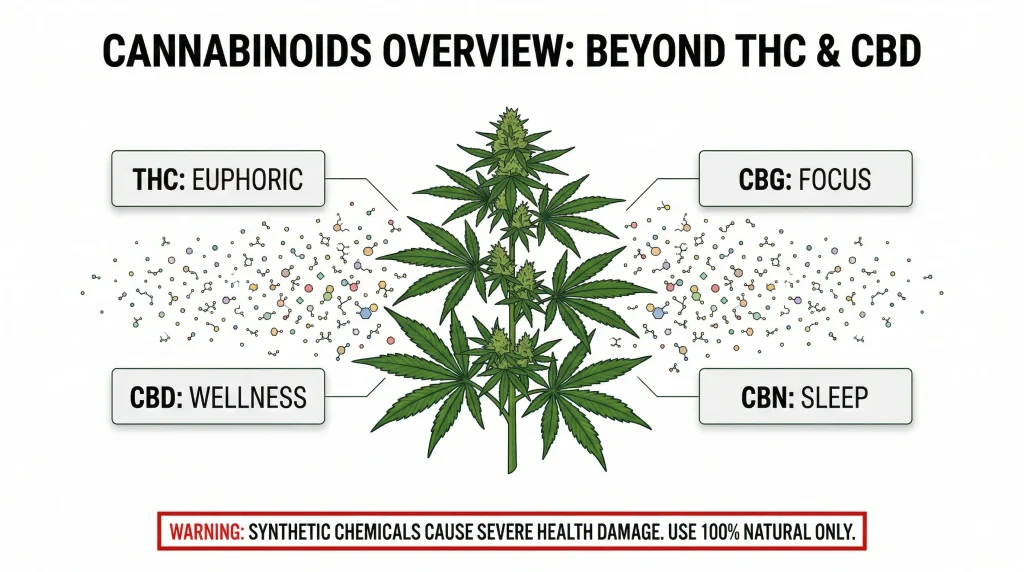
A cannabinoid is a broad scientific category of compounds that includes plant-derived phytocannabinoids, endocannabinoids produced inside the human body, and lab-made synthetic cannabinoids. This article explains how those groups differ, how they relate to cannabinoid receptors CB1 and CB2, and why THC and CBD are only two well-known examples rather than the whole story. It also covers the endocannabinoid system, the roles of anandamide and 2-AG, and the practical differences between major and minor phytocannabinoids such as CBG, CBN, and CBC.
What Is a Cannabinoid and Why It Is Not Just THC or CBD?
A cannabinoid is best understood as a scientific umbrella term, not as a synonym for cannabis, THC, or CBD. In the sources I reviewed, the word covers plant-derived compounds, substances your body makes, and lab-made chemicals that interact with cannabinoid receptors. That wider frame matters because THC and CBD are only two well-known examples, and the name alone tells you nothing about psychoactivity, legal status, or medical evidence.
Cannabinoids as an Umbrella Term for Plant, Human, and Lab-Made Compounds
The most practical way to sort cannabinoids is by origin. The U.S. FDA scientific memorandum on CBD groups compounds that act on cannabinoid receptors into three broad families: phytocannabinoids, endocannabinoids, and synthetic cannabinoids. Thailand’s Department of Medical Services guidance uses a similar medical distinction when it discusses plant cannabis extracts, endogenous cannabinoids, and the CB1 and CB2 receptors. In plain terms:
- Phytocannabinoids come from plants, especially Cannabis sativa. THC, CBD, CBN, CBG, CBC, and their acidic precursors are examples discussed in the chemistry and regulatory literature.
- Endocannabinoids are made inside the human body. Anandamide (AEA) and 2-arachidonoylglycerol (2-AG) are the two most commonly cited examples.
- Synthetic cannabinoids are laboratory-made compounds. They are not simply “natural cannabis” in another form, and the toxicology review I checked treats them as a separate, high-risk class.
Semi-synthetic cannabinoids are sometimes placed in a fourth practical category, but that label can be used loosely. I would not treat “semi-synthetic” as proof of safety, legality, or medical approval without checking the exact compound and the product rules that apply to it.
How Cannabinoid Receptors Shape the Scientific Definition
A second definition focuses on what the compound does: a cannabinoid can be described as a substance that interacts with cannabinoid receptors. The two main receptors discussed in the Thai DMS guidance are CB1 and CB2. CB1 is associated with the brain and many body functions, while CB2 is found in immune and peripheral tissues. That receptor-based definition is useful, but it is not a complete safety label. The phytocannabinoid review notes that plant cannabinoids may also interact with TRP ion channels and PPARs, not only CB1 and CB2. So if you see “cannabinoid” on a product or in a study, ask two questions: where does the compound come from, and what evidence exists for that specific compound, dose, formulation, and condition? The word itself does not answer those questions.
The Main Types of Cannabinoids by Origin
Origin is the cleanest first filter because it tells you where a cannabinoid comes from before you start comparing effects or legal status. Under that filter, the main groups are phytocannabinoids from plants, endocannabinoids made inside the body, and synthetic cannabinoids made in a laboratory. A fourth practical label, semi-synthetic cannabinoids, sits between plant-derived and lab-made chemistry, and it should be treated as a production description rather than a promise of safety, legality, or medical approval.
| Group | Where it comes from | Common examples | Key caution |
|---|---|---|---|
| Phytocannabinoids | Mainly Cannabis sativa | THC, CBD, CBG, CBN, CBC, acidic precursors | Plant origin does not mean legal, safe, or medically approved |
| Endocannabinoids | Produced naturally in the human body | Anandamide, 2-AG | They are not THC, CBD, or plant extracts |
| Synthetic cannabinoids | Made in a laboratory | Structurally diverse new psychoactive substances | Risk, potency, and legal status vary and can be serious |
| Semi-synthetic cannabinoids | Chemically altered from a natural cannabinoid | Depends on starting molecule and process | The label alone tells you little about regulation or evidence |
Phytocannabinoids from Cannabis sativa and Other Plants
Phytocannabinoids are plant-derived cannabinoids, and Cannabis sativa is the main source discussed in the scientific and Thai medical literature. The phytocannabinoid chemistry review I used describes them as a diverse group of isoprenylated resorcinyl polyketides, with compounds such as CBG, CBD, delta-9-THC, and CBC appearing alongside their acidic precursors. That last point is easy to miss: raw plant material contains acidic forms like THCA and CBDA, and heat, light, or oxygen can convert them into better-known neutral forms such as THC and CBD.
Other plants may contain compounds that interact with cannabinoid receptors, but I would not casually call them phytocannabinoids in the same sense as Cannabis-derived compounds. The chemistry is not identical, the research base is different, and the legal treatment can be completely separate. If you see a product marketed as a “plant cannabinoid,” check whether the claim refers to a Cannabis compound, another plant compound, or a blend.
Endocannabinoids Made Naturally in the Human Body
Endocannabinoids are cannabinoid-related molecules your body produces on its own. The two most frequently cited examples are anandamide (AEA) and 2-arachidonoylglycerol (2-AG). They are not plant compounds, they are not THC or CBD, and they are not something you consume as a cannabis product. They are part of normal physiological signaling, which is why the word “cannabinoid” can describe something that already exists inside you.
This distinction matters because it prevents a common category error. A study about an endocannabinoid is not automatically a study about THC or CBD. A product that claims to “support the endocannabinoid system” is not the same as a regulated medicine that contains a specific cannabinoid at a specific dose. Those are different scientific and regulatory questions.
Synthetic and Semi-Synthetic Cannabinoids Are Not the Same as Natural Cannabis
Synthetic cannabinoids are laboratory-made compounds that interact with cannabinoid receptors or produce cannabis-like effects. The toxicology review I checked describes them as structurally diverse new psychoactive substances, with variable composition and potency that can exceed natural cannabis in some cases. That review also records associations with acute poisoning and deaths. For that reason, I would not treat “synthetic cannabinoid” as a neutral synonym for natural cannabis, CBD, or a safe legal high.
Semi-synthetic cannabinoids are usually made by chemically modifying a naturally occurring cannabinoid. That can sound more familiar or more natural than “fully synthetic,” but the description does not establish safety, dosing, quality, or legal status. Some lab-made cannabinoid-related medicines exist in regulated medical systems, but that does not make every synthetic or semi-synthetic cannabinoid a medicine. In practice, you need the exact compound name, the product category, the dose, and the current rules in the country where you are asking the question.
How the Endocannabinoid System Connects Receptors, Molecules, and Signaling
The endocannabinoid system is not a single organ you can point to on an anatomy chart. It is a distributed signaling system that includes cannabinoid receptors, the endocannabinoids your body makes, and the processes that regulate them. The Thai DMS guidance and the FDA scientific memorandum both describe this system in similar terms: CB1 and CB2 are the two main receptors, while anandamide and 2-AG are the two most commonly studied endocannabinoids. Understanding this system helps you separate natural body signaling from plant-derived compounds like THC and CBD, and from lab-made synthetic cannabinoids.
CB1 and CB2 Receptors and Where They Appear in the Body
CB1 and CB2 are the two cannabinoid receptors most often discussed in medical and scientific sources. The Thai DMS guidance describes CB1 as being associated with the brain and many body functions, while CB2 is found in immune and peripheral tissues. That distribution matters because it explains why cannabinoid-related effects are not limited to one organ or one type of cell. A compound that interacts with CB1 may influence neurological or behavioral processes, while a compound that interacts with CB2 may be more relevant to immune or inflammatory pathways.
However, receptor binding is not the whole story. The phytocannabinoid review I used notes that plant cannabinoids can also interact with TRP ion channels and PPARs, not only CB1 and CB2. That means “cannabinoid” does not guarantee a single mechanism of action. When you read about a cannabinoid’s effects, check whether the study is talking about CB1, CB2, another target, or a combination. This is one reason why general statements like “cannabinoids affect the brain” are too broad to be useful for decision-making.
Anandamide and 2-AG as Key Endocannabinoids
Anandamide (also called AEA) and 2-arachidonoylglycerol (2-AG) are the two endocannabinoids most frequently cited in the sources I reviewed. The FDA memorandum identifies them as the most common endogenous examples, and the Thai DMS guidance also lists them as key endocannabinoids. These molecules are produced naturally in the human body and are not the same as THC, CBD, or any plant extract. They participate in normal physiological signaling, which is why the endocannabinoid system is considered part of the body’s own regulatory machinery.
A common mistake is to assume that because a product or study mentions endocannabinoids, it is automatically about cannabis or a cannabis-derived medicine. It is not. Endocannabinoids are investigated for their roles in various body functions, but that research does not transfer directly to plant cannabinoids or synthetic compounds. If you are evaluating a health claim, ask whether the evidence concerns an endocannabinoid, a phytocannabinoid, or a synthetic cannabinoid, and whether the study was in cells, animals, or humans.
Why the Endocannabinoid System Is Not a Single Organ
The endocannabinoid system is better described as a network than as a single organ. It involves receptors (CB1 and CB2), signaling molecules (anandamide and 2-AG), and the enzymes that make and break down those molecules. These components are distributed across the brain, immune system, and peripheral tissues. That is why you cannot say cannabinoids “affect the liver” or “affect the brain” as a universal rule. The specific effect depends on which receptor is involved, which compound is present, where it acts, and at what dose.
This distributed nature also explains why the endocannabinoid system is studied in many different contexts, from pain and inflammation to metabolism and mood. But studying a system is not the same as proving that a specific external cannabinoid will treat a specific condition. The system’s complexity is exactly why I avoid broad claims like “cannabinoids balance the endocannabinoid system.” Such statements sound scientific but do not tell you what is actually supported by evidence. For practical purposes, treat the endocannabinoid system as a biological framework for understanding how some cannabinoids might act, not as a target you can casually adjust with any product.
THC, CBD, and Other Plant-Derived Cannabinoids
Most people encounter cannabinoids through the names THC and CBD, but the plant produces dozens of related compounds, and the labels “major” and “minor” describe how much is typically present—not how strong or how safe each one is. This section helps you distinguish the well-known psychoactive and non-euphoric options from the broader spectrum that includes CBG, CBN, CBC, and acidic precursors. Getting these categories straight is essential before you interpret any product claim or research headline.
THC, CBD, and the Difference Between Psychoactive and Non-Euphoric
Delta-9-tetrahydrocannabinol (THC) is the main psychoactive cannabinoid in cannabis, and it is the compound most associated with the “high” that recreational users describe. The Thai DMS guidance states that THC has psychoactive properties, while cannabidiol (CBD) does not produce the euphoric psychoactive effect caused by THC. That does not mean CBD has no effects at all—it means the specific intoxicating effect people call “high” is primarily attributed to THC. The FDA memorandum also lists both THC and CBD as common plant-derived cannabinoids, alongside CBN, and it distinguishes them from other plant chemicals like terpenes, which are not cannabinoids.
I regularly see two mistakes here. The first is treating “psychoactive” and “medicinal” as opposites. A compound can be psychoactive and still have medical applications, and a non-euphoric compound can still have side effects or interact with other medicines. The second mistake is assuming any product labeled “CBD” is automatically THC-free or non-intoxicating. In reality, product composition depends on the source, extraction, and quality control, so if intoxication matters to you, you need a certificate of analysis, not a marketing label.
CBG, CBN, CBC, and Acidic Precursors in the Plant Spectrum
Beyond THC and CBD, the plant spectrum includes cannabigerol (CBG), cannabinol (CBN), cannabichromene (CBC), and their acidic forms such as CBGA, THCA, CBDA, and CBCA. The phytocannabinoid review describes these as part of a diverse group of plant compounds that can change under heat, light, and oxygen. For example, THCA and CBDA are acidic precursors found in raw plant material, and they can convert to THC and CBD when heated—a process often called decarboxylation. That is why raw cannabis and heated cannabis can produce different effects.
The FDA memorandum also lists CBC, CBG, CBGA, CBDV, and THCV among plant-derived cannabinoids, but it does not claim they are interchangeable with THC or CBD. Each compound has its own pharmacology, research status, and regulatory treatment. I would not assume that because CBG or CBN is “plant-derived” or “minor,” it is automatically legal, safe, or medically effective. The name on the label is a starting point, not a conclusion.
Why Major and Minor Phytocannabinoids Are Not a Potency Ranking
Major phytocannabinoids is a term often used for THC and CBD because they tend to be the most abundant in many cannabis varieties. Minor phytocannabinoids refers to compounds typically present in smaller amounts, such as CBG, CBN, CBC, and THCV. This is a statement about relative quantity in the plant, not about strength, medical value, or safety. A minor cannabinoid can be potent at low doses, and a major cannabinoid can be weak in a particular formulation. The phytocannabinoid review also notes that plant chemistry is dynamic, so the same variety can produce different ratios depending on growing conditions and processing.
If you are comparing products, do not rely on “major” versus “minor” as a shorthand for effect. Instead, look for the specific compound name, the amount per dose, the presence of other cannabinoids or terpenes, and whether the product has been tested for purity and consistency. And remember that most of the research on minor cannabinoids is still early-stage compared with THC and CBD, so claims about their unique benefits should be read with extra caution.
Why Cannabinoid Research Does Not Automatically Establish a Medical Use
A headline saying “cannabinoid shows promise” is not the same as an approved medicine you can safely use for a specific condition. The cannabinoid family includes plant compounds, endocannabinoids, synthetic compounds, and semi-synthetic derivatives, and each one has its own pharmacology, dosing questions, and regulatory status. I treat research findings as a starting point for questions, not as a prescription. That distinction matters most in Thailand, where the DMS medical guidance is written for medical services and professionals, not as a general authorization for self-treatment or everyday product use.
Evidence Must Be Read by Compound, Formulation, Dose, and Condition
Cannabinoid evidence is not one body of proof that applies to every compound. A study on THC does not automatically tell you about CBD, CBG, or CBN, and a study on an oral capsule does not automatically apply to an inhaled product, a topical, or a food. I use a four-part checklist before I take any cannabinoid claim seriously:
- Compound: Which specific cannabinoid is being studied—THC, CBD, a minor phytocannabinoid, an endocannabinoid, or a synthetic?
- Formulation: Is it a plant extract, an isolated molecule, a regulated medicine, or an unregulated consumer product?
- Dose and route: How much was used, how often, and by which route—oral, inhaled, topical, or another method?
- Condition and population: Which health condition, which patient group, and under what clinical supervision?
If any one of those pieces is missing, the finding cannot be transferred to a different product or person. The Thai DMS guidance reinforces this by framing medical cannabis extract use within professional medical services, not as a general wellness or self-medication pathway. The FDA CBD memorandum is also specific to CBD, which is why I do not treat it as evidence for every cannabinoid. The practical takeaway is simple: ask what exactly was studied, in whom, at what dose, and for what condition—before you assume it applies to you.
Regulated Medical Cannabinoid Products Versus Novel Synthetic Cannabinoids
There is a major difference between a regulated medical cannabinoid product and a novel synthetic cannabinoid sold outside medical channels. A regulated product has a defined identity, quality control, dosing information, and legal oversight in the jurisdiction where it is authorized. A novel synthetic cannabinoid, by contrast, may be chemically variable, may contain unknown potency, and may be sold as a “legal high” or research chemical without any assurance of purity or safety. The toxicology review I checked describes synthetic cannabinoids as structurally diverse new psychoactive substances, with some substances acting more strongly at cannabinoid receptors than natural cannabis, and it records associations with acute poisoning and deaths.
That difference is why I never treat “cannabinoid” as a green light. A regulated medical product and a synthetic street drug can both interact with cannabinoid receptors, but their risk profiles, legal status, and clinical context are completely different. If you are in Thailand and considering a medical cannabinoid product, the DMS guidance points toward professional medical evaluation rather than general consumer use. If you encounter a product labeled “synthetic cannabinoid,” treat it as a separate high-risk category, not as a natural cannabis alternative.
Safety and Toxicology Limits You Should Not Ignore
Safety does not come automatically with a plant origin or a familiar name. THC is psychoactive, and its effects on perception, coordination, and mood are well known. CBD does not produce the THC-like euphoric high according to the Thai DMS guidance, but that does not mean it is free of side effects or drug interactions. Minor phytocannabinoids such as CBG, CBN, and CBC have less research behind them, so claims about their safety or benefits should be read with extra caution. Synthetic cannabinoids have been linked in toxicology reviews to serious harms, including acute poisoning and death, and their composition can vary widely from batch to batch.
Three limits come up again and again in the sources I reviewed. First, product quality matters: without testing for cannabinoid content, contaminants, and consistency, you do not know what you are actually taking. Second, clinical evidence is condition-specific: a finding in one patient group does not automatically apply to another. Third, legal status is jurisdiction-specific: a compound that is legal or medical in one country may be restricted elsewhere, and Thai rules should be checked against current official sources rather than assumed from foreign articles. I would rather give you those boundaries than pretend a single study or product label can settle the question for everyone.
Scientific Terms and Thailand-Specific Context That Need Separate Verification
English-language science articles and Thai medical guidance do not always line up word for word, and that gap matters when you are trying to understand what is legally or clinically relevant in Thailand. The Thai Department of Medical Services (DMS) guidance I reviewed is written for medical services and professionals, and it focuses on plant cannabis extracts used in medical contexts. It is not a general product guide, and it does not automatically authorize everyday use, self-treatment, or any specific commercial product. I treat it as a reliable source for terminology and basic physiology—such as THC, CBD, CB1, CB2, anandamide, and 2-AG—but not as a substitute for current legal or clinical advice.
What the Thai DMS Guidance Can and Cannot Support
The DMS guidance is useful for understanding how Thai medical authorities frame cannabinoids in a clinical setting. It confirms that THC is psychoactive while CBD does not produce the THC-like euphoric effect, and it describes CB1 and CB2 as the two main cannabinoid receptors. It also acknowledges that the human body produces endocannabinoids such as anandamide and 2-AG. Those points are consistent with the international scientific sources I used, so I am comfortable using the DMS guidance to explain basic definitions and receptor biology.
What the DMS guidance cannot do is tell you whether a particular product is legal to buy, whether a specific dose is appropriate for you, or whether a given health claim is approved. The document’s purpose is to guide medical professionals in using cannabis extracts within medical services, not to serve as a consumer product manual. If you are making a personal medical or legal decision, the DMS guidance is a starting point for questions you should bring to a qualified professional or a current official source—not a final answer.
Why 2024 Medical Guidance Should Not Be Treated as Today’s Full Regulatory Position
The DMS guidance I reviewed is the sixth edition dated 2024. It reflects the medical understanding and regulatory context at that time. Because regulations, product approvals, and clinical recommendations can change, I do not automatically treat its contents as the complete current position for 2026. I also do not upgrade the year to the present just because the date has changed. If a statement in that guidance is still accurate today, it should be confirmed against the latest official version or a more recent announcement from the Thai Ministry of Public Health or DMS.
This is not a reason to dismiss the guidance—it remains a valuable source for definitions and medical framing—but it is a reason to be careful with anything that could affect your health, your money, or your legal standing. For example, if you see a 2024 statement about which professionals can prescribe cannabis extracts, or which product categories are permitted, do not assume the same rule applies unchanged in 2026. Check the current official source before acting.
When to Check Official Thai Sources Before Acting
I recommend checking current official Thai sources whenever your question involves any of the following:
- Legality: Whether a specific cannabinoid, product, or concentration is legal to possess, buy, or sell in Thailand.
- Medical use: Whether a product is approved for a specific condition, and who is allowed to prescribe or dispense it.
- Dosing and safety: How much to use, how to use it, and what interactions or side effects to watch for.
- Commercial claims: Whether a label’s health or wellness claims are permitted and verified.
- Travel and import: Whether you can bring a cannabinoid product into or out of Thailand.
For those questions, the Thai Ministry of Public Health, the DMS, the Thai FDA, and other official channels are more appropriate than a general science article written in English. I would also be cautious with any article that cites a 2024 guidance as if it were the latest word without checking for updates. The science of cannabinoids is evolving, and the rules around them can change faster than the underlying biology. Separating the stable scientific definitions from the changeable regulatory details is the safest way to use this information well.
FAQ
These are the questions readers ask most often when they first encounter the word “cannabinoid.” I’ll answer each one directly, while keeping the same distinction I’ve used throughout this article: cannabinoid is an umbrella term, and the details depend on which compound, product, dose, and jurisdiction you are talking about.
What exactly is a cannabinoid?
A cannabinoid is a compound that fits at least one of two complementary definitions. Under the origin-based definition, it is a member of a broad family that includes plant-derived cannabinoids (phytocannabinoids), cannabinoids your body makes (endocannabinoids), and laboratory-made cannabinoids (synthetic cannabinoids). Under the receptor-based definition, it is a compound that interacts with cannabinoid receptors such as CB1 and CB2. THC and CBD are two well-known examples, but they are not the whole category. The FDA memorandum and the Thai DMS guidance both use this broad framing, and the phytocannabinoid review adds that plant cannabinoids may also act on other targets such as TRP channels and PPARs.
Are cannabinoids good or bad for you?
There is no single good-or-bad answer for all cannabinoids, because the category includes very different compounds with different effects, evidence levels, and risks. THC is psychoactive and can impair perception and coordination. CBD does not produce the THC-like euphoric high according to the Thai DMS guidance, but that does not mean it is free of side effects or drug interactions. Minor phytocannabinoids such as CBG, CBN, and CBC have less research behind them, so claims about their benefits should be read with extra caution. Synthetic cannabinoids are a separate, higher-risk category and have been associated in toxicology reviews with acute poisoning and deaths. Whether a specific cannabinoid is helpful or harmful depends on the compound, dose, formulation, route, the person using it, and the condition being addressed.
Is cannabinoid addictive?
Addiction is not a property of the whole cannabinoid family—it depends on the specific compound, product, and pattern of use. The sources I reviewed do not support a single blanket statement that “cannabinoids are addictive” or “cannabinoids are not addictive.” What I can say is that THC is psychoactive and has been associated with dependence in some users, which is why the Thai DMS guidance frames medical cannabis extract use within professional medical services rather than casual self-use. CBD is generally discussed differently from THC in this context, but that does not make it risk-free. Synthetic cannabinoids are a separate concern, with higher potency and serious harms reported. If you are worried about dependence for yourself or someone else, that is a question for a qualified health professional, not a general article.
Does cannabinoid get you high?
Not all cannabinoids get you high. The “high” people describe is primarily attributed to THC, which the Thai DMS guidance identifies as psychoactive. CBD does not produce the THC-like euphoric psychoactive effect. Endocannabinoids such as anandamide and 2-AG are produced naturally in your body and are not intoxicating in the way people mean when they talk about getting high. Minor phytocannabinoids like CBG, CBN, and CBC are less well studied, so I would not assume they are intoxicating or non-intoxicating without specific evidence. And synthetic cannabinoids can produce strong effects that are not the same as natural cannabis, which is one reason they are treated as a separate risk category.
Which organ do cannabinoids affect?
Cannabinoids do not affect just one organ. The endocannabinoid system is distributed across the body, with CB1 receptors associated with the brain and many body functions and CB2 receptors found in immune and peripheral tissues. That is why you cannot say cannabinoids “affect the liver” or “affect the brain” as a universal rule. The specific effect depends on the compound, the receptor it interacts with, where that receptor is located, the dose, and the route of administration. Some plant cannabinoids also interact with targets beyond CB1 and CB2, such as TRP channels and PPARs, which adds another layer of variation. The practical answer is: it depends on which cannabinoid and which body system you are asking about.
Why are cannabinoids banned?
There is no single global answer, because cannabinoid rules vary by country and by compound. Some jurisdictions restrict THC and cannabis-derived products while allowing CBD under specific conditions. Others regulate certain cannabinoid-based medicines while banning recreational cannabis. Synthetic cannabinoids are often treated as new psychoactive substances and are controlled separately from natural cannabis. In Thailand, the DMS guidance focuses on medical cannabis extract use within professional medical services, and it is not a general authorization for consumer products or self-treatment. Because rules can change, and because a compound that is legal in one country may be restricted in another, I recommend checking current official Thai sources—such as the Ministry of Public Health, the DMS, and the Thai FDA—before making any personal, medical, or commercial decision about a specific cannabinoid product.
References
- คำแนะนำการใช้สารสกัดจากกัญชาในทางการแพทย์(Department of Medical Services, Ministry of Public Health, Thailand)
- Phytocannabinoids: a unified critical inventory(Royal Society of Chemistry / Natural Product Reports)
- Scientific Memorandum: Cannabidiol (CBD)(U.S. Food and Drug Administration)
- The synthetic cannabinoids phenomenon: from structure to toxicological properties. A review(Critical Reviews in Toxicology)